Quantcast

Students Enter Virtual World of Finance (Second Life)


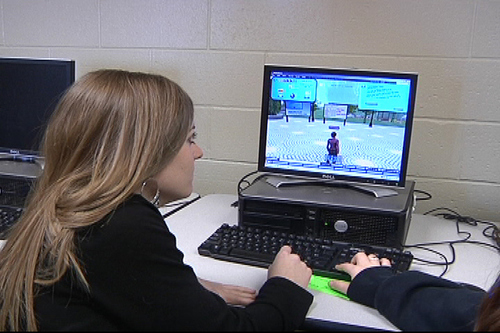
Students at Maine Endwell High School have entered in to a virtual world in order to learn about financial planning for their future.
Visions Federal Credit Union provides this free educational tool.
Maine Endwell is the first school in New York State to use the game, Modoh Island.
“Our hope is that eventually it will be something that the teachers can use to supplement their classroom without our hands on in it,” says Colleen Barton, Youth Educator for Visions Federal Credit Union.
To play, students create an Avatar and start with $10,000 dollars.
They have to make choices from buying cars to paying school loans, and buying or renting a home.
“I just picked the basic schooling and I was just careful about the car, and I picked a smaller house, cheaper and cheaper car. Smart decisions for then and now I can get a nicer car and house,” says Julie, an 11th grade student.
Via www.wbng.com
Popularity: 1% [?]


EVE Online offers lessons for the financial crisis


Uh-oh! Another big bank is the subject of a depositor run amid charges its chairman has run off with customers’ money. Thankfully, this scandal is only taking place in Eve Online, a space-age virtual reality created by CCP, a games developer and Iceland’s coolest company. But Ebank’s troubles in the ether may offer some valuable lessons for earthly banking and regulation.
Eve is one of the more successful so-called massively multiplayer online games. Some 300,000 people – as it happens, nearly equal to the population of Iceland – pay $15 a month to navigate characters that pilot inter-galactic spaceships, manufacture and trade goods, mine resources and enter into big alliances – or bloody battles – with one another.
Central to Eve’s strategy, players develop economies within an “anything goes,” free markets framework that allows them to expand their fleets, buy weaponry and equipment and bolster defences. Indeed, Eve boasts 66 different marketplaces for some 5,000 items, with more than a million transactions a day.
Enter Ebank. Because players often do not have the interstellar credits – abbreviated to ISK, also the official abbreviation of the Icelandic krona – they need to expand their fleets, an enterprising player created a bank that would accept deposits and lend to players who would pledge assets, like their spacecraft, as collateral.
Via www.telegraph.co.uk

Popularity: 1% [?]

Ultima Returns as Browser-Based F2P MMO Strategy Game


Electronic Arts and Aeria Games have jointly announced the launch of Lord of Ultima, a new addition to the Ultima franchise that can be played within a browser.Following the successful launch of Battlefield Heroes and Need for Speed World, Lord of Ultima is the latest, and third, title Aeria Games has released from its multi-game deal for EA’s portfolio of Play4Free games.”Set in the legendary Ultima universe, the game transports players to the new world of Caledonia where players aim to grow their capital on the path to glory,” reads the description. “By exploring new continents and forging a vast empire, players will master the art of diplomacy and trade as well as the military activities of spying, plundering, and conquering enemy cities. Players can mark their place in history by attaining the mighty and feared status as Lord of Ultima.”
Via www.tomshardware.com

Popularity: 1% [?]

Aussie R18+ legislation aiming for Jan. 2013 introduction


Australian gamers can expect to have an R18+ classification for games by January 1, 2013, according to the federal government.Federal Minister for Home Affairs Jason Clare today introduced the R18+ bill in parliament and announced the federal government expects the R18+ for games legislation to officially come into effect next year.Last month, Clare announced his intention to stick to former Federal Minister for Home Affairs Brendan O’Connor’s previous plans in introducing the R18+ legislation in the February 2012 session of parliament.Clare has stayed true to this plan, officially introducing the R18+ for games bill in parliament today.
Via au.gamespot.com

Popularity: 1% [?]

Credit card thieves target OpenSim grids


Credit card thieves have figured out a way to steal money from OpenSim grid owners.

They take the credit cards, and use them to purchase virtual currency from the grids. Then they turn around and redeem the currency for cash before the card holder notices the theft and complains. The credit card company reverses the transaction and now the grid is out the full amount — plus the time spent dealing with the issue.

Any grid that issues its own virtual currency and allows it to be redeemed is potentially vulnerable. Second Life, for example, to combat against this kind of fraud, has a security API in place for third-parties that trade its currency, such as outside currency exchanges, as well as internal controls.
Via www.hypergridbusiness.com

Popularity: 1% [?]

Academic Research Paper on OpenSim Community


While the nature of the firm has long been established as the dominant form of organizing for value creation, emergent forms of organizing such as the private-collective community model have recently gained attention from researchers and practitioners. Little is known about how such communities, where private goods from stakeholders are shared and freely distributed among a public collective, sustain themselves. The purpose of this research is to examine how the resources, stakeholders, and overarching network structure in which these are embedded influence the sustainability of the community. Using semi-structured interviews, archival data, and social network analysis, we explore these items in detail and provide initial findings from an ongoing research study of the OpenSim community. We conclude with future directions, expected contributions, and the limitations of this line of research.
Via nordicworlds.net

Popularity: 1% [?]

Virtual reality contact lenses beam images directly into your eyes


Contact lenses which focus 3D screens directly into people’s eyeballs could be on sale as early as 2014, says U.S. company Innovega.
The tiny ‘screens’ sit directly on users’ eyeballs and work with a pair of lightweight glasses with a built-in translucent screen.
The experience is equivalent to a 240-inch television viewed at a distance of 10 feet, says Innovega’s CEO Steve Willey.

Via www.dailymail.co.uk

Popularity: 1% [?]