Quantcast

Habbo Hotel – Australia’s growth story

Habbo Hotel is arguably the largest virtual world in existence, with well over 100 million registered avatars (as of June 2008) and ongoing growth. There’s an Australian Habbo portal and in the past fortnight Habbo developer Sulake announced the launch of their in-world currency, the ‘pixel’. Habbo already has a credit system where real-world money can be exchanged for a range of virtual items. The ‘pixel’ addition is more of an achievement-driven option – logging in regularly, paying to join the Habbo Club and staying online longer all give the user ‘pixels’, which can be used to ‘rent’ special effects for virtual rooms or avatars:

New effects include hover-boards that let Habbos glide around the virtual world, a ‘frozen’ avatar that turns a Habbo into a moving block of ice, or bubble machines that blow bubbles into virtual rooms. The pixel economy will be constantly developed based on user feedback.

habbo_australia

I took the opportunity to quiz Sulake’s Regional Director Asia Pacific, Jeff Brookes, on the currency announcement and Habbo Australia’s popularity to date:

Lowell: Can you summarise the Australian demographics for Habbo to date? Of the 3.6 million characters, how many unique users are there?

Jeff Brookes: Habbo Australia receives 25,690,252 page impressions per month and, as you know, has 3.6 million registered Habbo-characters. It has 278,509 unique browsers per month and users spend on average 1.00.02 hours per user session on Habbo, which is over twice as much as any other teen website, according to November 2008 figures from Hitwise.

Lowell: What are your primary objectives with the new currency? Are there any plans to allow users to cash out their credits for real world currencies?

Jeff Brookes: The primary objective with the new Pixels currency is to reward Habbo users for their loyalty. We feel that it is important to reward our devoted users, encourage them to spend more time within the Habbo world and provide them with innovative ways for them to enjoy their experiences within Habbo. Pixels are earned by Habbo users in various ways, such as: signing into Habbo once a day, earning more pixels the longer users stay online in Habbo, completing certain achievements, working as a Guide, and giving respect to other users. With Pixels, users can rent certain items for a specific amount of time, have cool effects for their Habbo character, and have discounts on a wide variety of ‘furni’ or virtual furniture that can be purchased with credits.

Habbo has no plans to allow users to convert Pixels to Habbo credits or any real world currencies.

Lowell:. Habbo arguably has one of the largest virtual world userbases – how does one ensure continued growth in an environment of escalating competition?

Jeff Brookes: We maintain and increase our growth by listening to what the users want . We ask Habbo’s to provide us with feedback on new campaigns, games, rooms, furni etc. We feel that it is important to be innovative and always put our users first.

What’s unique about Habbo is that it is specifically designed for teenagers – the layout, content and activities on offer are continually changed and updated. Habbo is updated every month to enhance the user’s experience. We do this so that our users can be constantly entertained and as with all teenagers, this is an important feature.

Keeping users excited and coming back depends upon the fundamentals, which for Habbo are allowing them to choose and personalize a character, browse the virtual world, walk around and chat and express themselves. The new Pixel currency encourages Habbo users to personalise their avatars and their virtual space further.

Habbo Hotel has certainly made in-roads into the Australian market. Achievement systems are common in gaming worlds in particular although rewarding people for spending more time has its downsides. Having spent a number of hours in the past year in Habbo, I can see its appeal. It also reinforces the potential success of Metaplace with its content creation features.

Popularity: 5% [?]
Metaplace: beta impressions

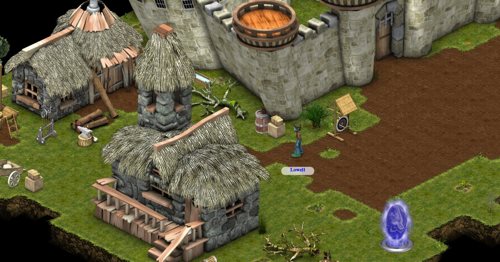
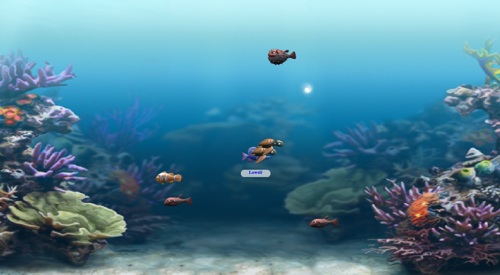
We first mentioned Metaplace over a year ago, and that year has been spent working toward a public beta. In the past week I received a beta invite and I’ve spent a number of hours using Metaplace. Overall, this is one impressive virtual world platform with enormous potential. It makes offerings like Google Lively seem just a little underdone to say the least.

My impressions of Metaplace so far:

1. Orientation as it should be

Any virtual world lives or dies on its initial impression to new users. Metaplace have obviously learnt from the mistakes of competitors by providing a highly integrated sign-up process. It looks slick but it flows nicely as well. The ‘Metaplace Hub’ is the central gathering point and it’s easily accessible at all times given the ever-present web interface.

2. Content creation is king

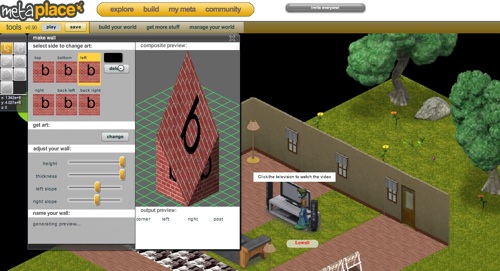
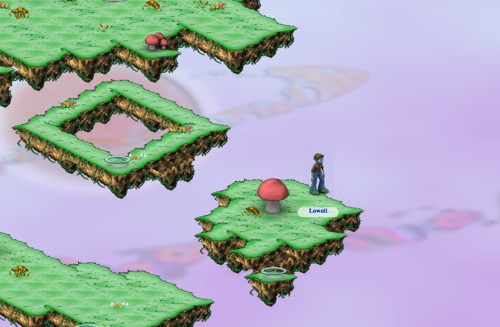
Second Life is arguably the best platform for unique content creation. Metaplace has some significant parallels but with a much simpler interface. From observing some of the chat amongst beta users there’s a lot more under the hood than initial impressions, but that simplicity is great for the inital learning curve. The tutorials are well integrated and The whole creation interface reminded me strongly of The Sims. For me the standout is the ability to directly import textures (tiles) from either your hard-drive or via a web image search courtesy of Yahoo – the imported images then merge seamlessly into your overall library.

Building structures is also fairly self-explanatory, with good preview functions. For users where content creation isn’t second nature, the interface will help them get started and hopefully more motivated to take on the deeper learning curve. Scripts, plugins, sprites and sounds are the key components you have to play around with once you’ve got a little more familiar with things. I’m no scripter so it’s hard to know how much complexity is built into the scripting options.

3. It has rewards hooks

From the moment you sign up to Metaplace, you start earning badges for standard activities like rating another user’s world or sending a private message. Metacreds are the currency of choice and they can be used to purchase virtual goods for your world. I don’t want to be repetitive, but the integration of the rewards gets a thumbs up. I also enjoyed the fact the rewards weren’t intrusive – it’s more an added bonus.

4. The user community is strong

Although by its very nature a beta means a smaller community, the one that exists seems strong. In the half dozen times I’ve logged in for an hour or so, there’s a constant stream of chat – mostly people answering questions from newer users on more complex content creation tasks. The web interface makes keeping in touch easy and a fairly standard ‘friends’ functionality exists.

5. Great Web / 3D integration

I’ve mentioned the integration aspects a few times, and with good reason. Because Metaplace runs within a standard web browser (I’ve used it successfully on both Firefox and Safari), it makes accessing the world so much simpler than say Second Life. Of course, there are trade-offs for that simplicity such as the graphical complexity of the world and arguably the degree of scripting that can occur. On the up-side, there’s good social networking tools, including the ability to follow any other user’s discussions via an RSS ‘Metastream’.

Another notable for Metaplace is its speed. Initial login takes around the same time as Second Life – the same for movement between areas. Managing private messages, rewards, profile info, avatar customisation and accessing tutorials all occur from the 2D web interface. It’s plain easy to use.

The sum up

The work put in by the Metaplace crew over the past year is really apparent. As a beta version, this is already an impressive virtual world platform that provides some meaty creative options for casual users that don’t want to spend days or weeks creating their space. If you haven’t signed up for a beta invite, consider doing so if you’re looking for something new in the virtual world space. If Metaplace had reached this stage of development 12-18 months ago, their success would have nearly been assured. In the explosion of new worlds under development now, competition is much tougher. That said, the quality of this offering is likely to win a lot of hearts and minds in the casual worlds space, whilst still intriguing the more hardcore content creator.

What do you think? Is Metaplace the sort of world you can see yourself spending significant time in? Does it open up options that other worlds currently can’t?

Popularity: 2% [?]

Raph Koster: MMOs versus MUDs

Metaplace’s Raph Koster has been around long enough to know most virtual world history. He’s raised some interesting points about MUDs and MMOs, stating that the latter have “removed more features from MUD gameplay than they have added”.

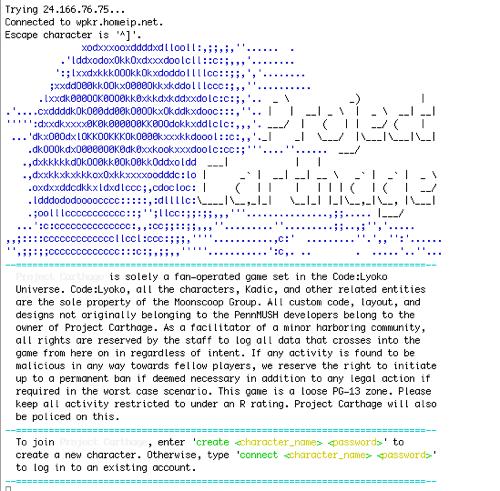
One of hundreds remaining: Project Carthage

One of the hundreds of MUDs still running: Project Carthage

What do you think? Is there truly anything new in multiplayer gaming or virtual worlds more broadly? What further evolution would truly impress you?

Popularity: 7% [?]

Metaplace is hotting up

Back in September 2007 we mentioned that Metaplace was a new kid on the virtual world block. That kid is growing up pretty quickly and in an interview this week, Metaplace founder (and virtual world guru) Raph Koster states that widespread access to Metaplace should be available by April. The likelihood is it’ll be free for users to build small virtual worlds, with costs kicking in as your world grows.

Metaplace is a service aimed at people designing their own worlds and potentially making money by charging others for the services they offer, with the ability to cash out virtual currency accumulated. The ‘create your own world’ approach reminded me of VastPark, and there are similarities. There’s a brief conversation on the two here.

I love the idea of being able to create my own world but the actual task seems daunting. The ease of use of the toolset will be crucial – it’s hard enough building basic structures in Second Life let alone trying to construct a whole world. On assumption we could all successfully build a world, what type would you build? I’d love to hear your suggestions / thoughts.

Thanks to Virtual Worlds News for the heads-up

Popularity: 2% [?]

Metaplace

It’s been fairly widely reported over the past week that there’s a new kid on the virtual world block. Metaplace has some significant backing and looks promising. Some key snippets from Metaplace’s company, Areae:

“We think there are all kinds of things on the Internet that would be improved if anyone could have a virtual place of their own”

“committed to an open markup standard for our network protocol – anyone can write a client for any platform they want. We decided to use Web standards for everything we could, which is why you can have a game world that is also a website, or use Web data to populate your world. The scripting language (we call it MetaScript, of course) is based on Lua. You get the idea – no ‘not invented here,’ no closed proprietary approaches”

metaplace.jpg

“We knew it was all coming together when one of our team made a game in a day and a half. And then stuck that game on a private MySpace profile. You can inherit someone else’s world (if they let you) and use it as a starting point. You can slurp whole directories of art and use them as building blocks. Cut and paste a movement system or a health bar from one world to another. Use an RSS feed for your NPCs. We made puzzle games, RPGs, action games… and set up doorways from one to the other”

“We fully intend to be customers of our own product. We’ve already started work on our first big game – a ‘worldy MMORPG’ with what we hope will be a ton of fun game play. What’s more, we figure that some of you who have been looking for a game like that might want to help us build it.”

Metaplace is at alpha testing stage and if you’re keen, you can sign up for that testing.

Popularity: 7% [?]