Quantcast

Metaplace enters Open Beta

metaplace-openbeta
Today the Metaplace team have announced the mover to Open Beta, so if you haven’t checked out this impressive 2D world with content creation, you now have no excuse not to do so.

If you want some insight into Metaplace’s founder, Raph Koster, you can check our interview with him here.

Things have evolved significantly since our impressions of the Closed Beta, but my thoughts haven’t changed: this is a potential game-changer of a virtual world.

Over to you: have you checked out Metaplace, and if so, has it captured your imagination or is it just another 2D option?

Popularity: 3% [?]
The monetisation of Metaplace

metaplace_april2009 The Alphaville Herald have an interesting post on the subscription options being considered for Metaplace.

In the month or so since I last spent some time in Metaplace, its further growth in users and related new worlds has become apparent. It’s a platform that has real potential to earn dollars for its creators, particularly given the content creation options it provides. One key point I’m encouraged on is Metaplace’s commitment to free accounts. It’s an approach that’s served Second Life well, as it has other 2D worlds like Habbo.

The combination of the content creation and what will hopefully be attractive pricing plus free accounts should set Metaplace up nicely. Hell, when the Alphaville Herald is positive, Metaplace must be doing something different to the norm.

Popularity: 3% [?]

Merged realities – events and issues for virtual worlds

1. This week we interviewed Draxtor Depres for Episode 9 of the TMJ Podcast. His latest commission is using machinima to represent classic Californian literature, and the latest product of that can be seen here:

2. Habbo Hotel’s parent company Sulake has released its financial results for calendar year 2008, showing annual revenue of 50 million Euros, 4.8 million of which ended up as profit. The Australian operation is upbeat, reporting a 29% increase in revenue growth (but no figures), with more than 25 million page impressions in the past 30 days.

3. Metaplace continue to expand their in-world options with the launch of an achievements system which allows earning of Metacreds. There’s also the ability to gain Coins which can be used to buy goods in-world:

Coins and Metacred can be earned by spending time on Metaplace and interacting with other worlds and people.  Commenting and rating on worlds, spending time in worlds, selling objects on the Marketplace, making and inviting friends, and posting in the forum are a few examples.


Popularity: 3% [?]

Merged realities – events and issues for virtual worlds

1. Habbo Australia have surveyed 4012 teenagers (12-18 year olds) on their concerns, with 81% citing the environment as a major issue, with an unsurprising emphasis on bushfires.

Habbo will be closing down for Earth Hour on March 28th at 8.30pm AEDT. What say you Linden Lab, Blizzard and others?

habbo_earthhour

2. The Alphaville Herald has some stunning pictures of Metaplace builds – it shows the potential power of a well-implemented 2D platform.

3. There’s been quite a lot of focus on this week’s announcement of Sparkle, which allows in-world text chat in Second Life and in OpenSim grids on the iPhone or iPod Touch. Here’s a brief demo:

More on Sparkle once we have a closer look in the next few days.

Popularity: 3% [?]

Video review of Metaplace

The MP Insider blog has a video review of a particular gaming area in Metaplace – Zoo Escape!. For those who haven’t seen Metaplace in action, it’s a useful heads-up on its form factor and its content creation options:

As stated previously, being web-based and having good content creation opportunities should prove an enticing package.

Popularity: 5% [?]

Merged realities: events and issues for virtual worlds

Two of our more popular features each week are our weekly mainstream news roundup, The Watch, and our weekly does of machinima, Weekend Whimsy. The former runs Mondays, the latter Fridays.

We’ve decided to add a new feature that will run in the middle of the week, called Merged Realities. It will be a handful of links to virtual world events, real-world events and non-mainstream coverage of virtual worlds issues. If you have an event that you think will be of interest, contact us with details. Either use our contact form or DM us on Twitter. If it’s Second Life related, feel free to IM Lowell Cremorne.

Onto the inaugural edition:

1. Mandy Salomon, Senior Researcher at the Smart Services Cooperative Research Centre, is giving a presentation on Second Life to the Women in Information & Communication Breakfast Series – if you’re Canberra based this is worth checking out.

2. Metaplace are having a stress test of their platform. If you’re a beta tester, you should have received an email with the details, otherwise log in to Metaplace to find out more. The stress test starts at 1pm PST on Thursday Feb 5th, which is 8am Friday the 6th of February AEDT.

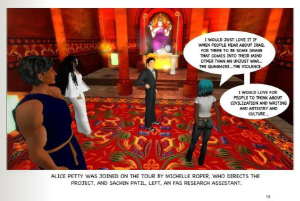
3. Dancing Ink Productions have released the findings from their Understanding Islam through Virtual Worlds project, conducted in partnership with the Carnegie Council for Ethics in International Affairs. I particularly like the graphic novel option for the findings.

islam

4. The Synthetic Worlds Initiative at Indiana University is out its Greenland world into open beta:

To test some ideas, we have prepared a browser-based game of kingdoms, trade, diplomacy, and warfare in the stone age. The world is called Greenland and it enters open beta today. We invite those interested in such things to help us by testing the environment and contributing reactions and criticism to the forums.

To enter Greenland, go to http://greenlandgame.com/ and choose the Mercator server (the other two servers are closed for internal testing).You will need a code to register for the server; it is GLOPENACCESS.

5. Check out this superb video of avatars as music-makers (via New World Notes):


Bandbots – Second Life Musical Avatars from Chantal Harvey on Vimeo.

Popularity: 3% [?]

Interview – Raph Koster, Co-founder and President, Metaplace

If the virtual worlds industry has elder statesmen, Raph Koster is definitely one of them. It’s a term he probably dislikes, but the reality is he’s had a direct involvement in some key milestones from text-based worlds (MUDs) through to the present day. After spending some time with his latest project, Metaplace, we took the opportunity to ask Raph some questions about its development as well as discussing some wider challenges and opportunities for virtual worlds. If you ever doubted that Raph Koster was a content creator to his core, pay particular attention to his response to the final question. ;-)

raph_koster1

Lowell: Let’s start with your baby, Metaplace. How’s it progressing?

Raph: It is going well — we are expanding our closed beta now, and we’ve had a lot of big changes going in and more to come as we accelerate towards opening up. Among recent changes have been the addition of a tool that allows you to select models from the Google 3D Warehouse and bring them into your world with just a few clicks. This has led to a huge explosion in the variety of things found in people’s worlds.

Lowell: Content creation is key to Metaplace – what excites you most about what Metaplace has to offer in that regard?

Raph: I think what is most exciting isn’t so much the power of Metaplace – that’s there for sure, and it’s hugely exciting and fascinating and great things can be made. But I find special attraction to the ease and simplicity, the fact that we’re unlocking very complicated stuff for a lot of people who don’t know how to 3D model, or script, or code. So I think for me, it’s the lowering of barriers that is most exciting.

Lowell: 2009 is being touted as the year of the avatar – what’s your take? Has the avatar gained enough traction to be a true aspect of popular culture?

Raph: I think avatars became commonplace a while back. They have morphed into profile pictures and gravatars and they’re simply everywhere. So I don’t know what “year of the avatar” means except to say that something ubiquitous has become universal.

Lowell: Back in 2007 you were quite emphatic that the games industry was overlooking the power of the web as a platform – do you think there’s any greater level of insight now or is there still a significant blind spot there?

Raph: I think it is evident that the game industry has caught on. EA now distributes on Steam. All the consoles have web browsers now. We have now seen multiple games conceived and developed on or for the web jump over to consoles. Web integration in the form of sharing achievements, exposing APIs, posting to web services, and so on, is becoming far more common. I think the pace of these developments is simply going to increase.

Lowell: Where do you see Metaplace gaining its market share from?

Raph: We can’t be all things to all people, of course, and as a UGC platform, it takes a while for every possible use to come to fruition. I would say that from the get-go, we’ll be a highly social, creative place with great ease of use, and anyone familiar with casual virtual worlds and “building” sorts of games and worlds will feel at home. But I also expect users to take us in many directions over time — that’s the beauty of enabling user-created content.

Lowell: Although Google Lively was only a competitor in the broadest sense, what lessons if any have you learnt from their experience and what do you think Google have taken away from the experience?

Raph: Well, I can’t speak for Google! To me, Lively always seemed aimed more at the IMVU-like, avatar chat sort of space. I do think it validated some of our choices — the decision to use Flash, for example, which has so much penetration and doesn’t require a download for anyone, or our emphasis on user-created content.

Lowell: The mainstream media have latched onto sex as a challenge for worlds like Google Lively and Sony’s Home. Have you started to formulate how Metaplace will deal with ‘vice’ issues?

Raph: We’re definitely not a kids’ world. In our Terms of Service we explicitly allow users to make worlds about anything, as long as they do not violate the law. But we also give them complete control over their world — nothing should be in there that the world owner doesn’t want. It’s a lot like having your own webpage, in that sense.

Lowell: As a writer, has anything recently in virtual worlds stood out for you as high-quality writing?

Raph: To be honest, I don’t think that writing has ever been a huge part of social virtual worlds. It’s had far far more of a presence in the RPGs, where it is really starting to get much better.

Lowell: Can you give an estimation of when you think Metaplace will have its full launch?

Raph: We expect the open beta launch will happen later this year.

Lowell: Aside from avatars, there’s some further momentum around virtual goods. What approach to virtual goods will Metaplace likely take in the coming year?

Raph: We will have our marketplace available, with all goods free at first. I am looking forward to seeing the amount of user-created content grow on there, and eventually outnumber our own creations. Metaplace is somewhat unique in that our virtual goods aren’t necessarily just pictures, but can enable unique behaviors and interactivity.

Lowell: Do you agree with the premise that in the near future we’re likely to see more significant regulation and legislation in regard to virtual worlds? If so, do you think we’re likely to see an initial
overreaction by governments?

Raph: It’s inevitable that more legislative or at least legal attention be paid to virtual worlds. And I also think that it is likely that there will be misunderstandings of what is fundamentally a new medium. A lot
of people in mainstream media made fun of the U.S. Congressional hearings on virtual worlds that were streamed into Second Life — and that just indicates a lack of familiarity with them.

So sure, there will probably be mistakes made. But there are industry groups working to make sure that policymakers understand the industry better, and with the rise of the Web as a common medium pretty much everywhere, I think we are seeing that the learning curve is not nearly as high as it once was.

Lowell: You recently blogged on the issue of losing virtual world history – can you see there ever being enough common goodwill to establish some sort of universal timeline / history?

Raph: Well, I know of several projects – the most active right now is probably Bruce Damer’s at http://www.vwtimeline.org/. And the MUD Wikia project, which attempts to capture the early text-based history of virtual worlds, seems to be off to a good start at http://mud.wikia.com.

Lowell: After spending my first few hours using Metaplace, it occurred to me that it’s ideally suited to having a MUD-format area – is that likely to be something driven by Areae or perhaps something created by the Metaplace community?

Raph: If you mean games, or collaboratively built games, our tools certainly enable it. Right now, we’re focused on providing somewhat more fundamental building blocks. There’s a lot of sorts of games! But many of our current users certainly enjoy making games, and more power to them!

Lowell: Business seems to be latching onto virtual worlds as a cost-saving, virtual meeting platform – does this offer any opportunities for Metaplace? Do you see the platform as having appeal for enterprise?

Raph: Honestly, I am not a huge fan of pursuing the enterprise market. I am more interested in the mass market, and the ways in which they can take virtual worlds to all sorts of new places. That said, if enterprises want to use Metaplace, we won’t stop them. But it’s not a target for us, we’re a consumer service.

Lowell: Leading on from that, there’ll only be widespread business acceptance of virtual worlds when easily quantifiable ROI can be established – do you think that’s likely to occur in the near future?

Raph: It’s difficult to say. Many of the ideal uses are around difficult to quantify usecases. Do virtual worlds fully replace face to face meetings? I am not sure they really do – going clear back to the text worlds, we have a tradition of user conventions, player luncheons, clan gatherings, and so on, to get virtual friends to meet face to face. There’s no doubt in my mind that virtual conferencing is then a value add, but it might not be quantifiable enough for a business right now.

Over time, as more of the web comes to include virtual places, as I believe it will, I think the value will become more evident.

Lowell: Getting totally away from virtual worlds, you’re a musician so I’ll ask a more obvious ‘desert-island discs’ question: what five albums couldn’t you live without?

Raph: I would trade five albums for a guitar in a heartbeat.

Popularity: 9% [?]