Quantcast

Virtual worlds and the law: free e-book

Virtual Justice – the new laws of online worlds by Greg Lastowka, is a 226 page tome devoted to the emerging area of law and its application to virtual environments. I haven’t read it all, but it’s a pretty comprehensive treatise on the whole field, with in-depth discussion of key precedents, virtual property law and a whole lot more.

Download it for yourself here – Greg Lastowka deserves some major kudos for making this available.

A thanks to io9 for the heads-up.

Popularity: 1% [?]

Crime and virtual worlds: the Australian take

Earlier this month, the Australian Institute of Criminology (AIC) released an issues paper titled Crime risks of three-dimensional virtual environments.

Written by Deakin University’s Ian Warren and Darren Palmer, its focus is identifying the potential harms of 3D virtual environments, discussing best governance approaches and identifying areas for future research.

The foreword, as you’d expect, sums the paper up nicely:

Three-dimensional virtual environments (3dves) are the new generation of digital multi-user social networking platforms. Their immersive character allows users to create a digital humanised representation or avatar, enabling a degree of virtual interaction not possible through conventional text-based internet technologies.

As recent international experience demonstrates, in addition to the conventional range of cybercrimes (including economic fraud, the dissemination of child pornography and copyright violations), the ‘virtual-reality’ promoted by 3dves is the source of great speculation and concern over a range of specific and emerging forms of crime and harm to users.

This paper provides some examples of the types of harm currently emerging in 3dves and suggests internal regulation by user groups, terms of service, or end-user licensing agreements, possibly linked to real-world criminological principles. This paper also provides some directions for future research aimed at understanding the role of Australian criminal law and the justice system more broadly in this emerging field.

The paper overall is certainly well thought out and covers some ground as far back as the early 90′s with the now infamous Mr Bungle episode. As we’ve said in our own paper on policy and virtual worlds, establishing acceptable governance mechanisms is certainly key to future growth and success of virtual environments. Papers like this one from the AIC help to get the issue on the agenda, but even in my most non-cynical frame of mind, I doubt there’ll be much local progress in the near future. That said, kudos to the AIC for being at the forefront, no matter how glacial the progress may end up being.

Read the full report here.

Popularity: 1% [?]

Brands under the hammer in Second Life

smolinaro-aug2009 The Second Life blogosphere is igniting with the news that the listing guidelines for Second Life’s marketplace, xStreetSL, have been tightened up.

Essentially, it’s now prohibited to sell any virtual goods that resemble a real-world brand. That’s no shock and probably reasonable. The contention is over the ban on avatars that resemble actual celebrities. It’s a pretty silly ruling that’ll be essentially unenforceable outside of the xStreetSL website. Admittedly, protecting brands is a balancing act for any company, but this appears to be an over-protective move.

Let me throw out another conundrum likely to occur in the future as a result of this decision. Let’s say an avatar becomes a celebrity in its own right. Its shape, clothing and skin may have been created from scratch or different aspects purchased from vendors. Could said avatar argue they are now a brand and prevent people creating avatars that resemble them? Avatars-as-brands well and truly exist now – it’s the policy developments like these that continue to push well beyond the traditional boundaries of intellectual property law. It’s going to take some serious legislative work in the medium term to create some solid ground under virtual world content creators.

Popularity: 1% [?]

The trademarking of an avatar

aimeewebertm229Late last year, Grossman Tucker Perreault & Pfleger announced that they had successfully registered as a trademark the multidimensional likeness of Aimee Weber, the Second Life avatar of New York content-creator and businesswoman Alyssa LaRoche.

While GTP&P referred to it as a groundbreaking decision (it is — groundbreaking is another word for ‘first’), it is not actually an astonishing, surprising or unexpected result. It’s an obvious application of existing trademark law, in fact.

What we have here is a trademark image in a new medium, but that isn’t particularly special. At some point in the future, someone is going to trademark a projected 3D holographic logo for the first time, and that will indeed be groundbreaking, but is still an obvious extension of the trademark system into new media and expressions.

What’s interesting here is that the trademark is, essentially, a personification. LaRoche’s avatar appearance, for all intents and purposes is her, which actually makes the avatar-as-a-trademark a good deal more ordinary than a lot of the existing trademarks that have been registered.

As a random example, the US Patent and Trademark office granted trademark registration for THE FORMULAR FOR KOFI’S CONCEPT IS SIMPLE. THE PAST + THE PRESENT = THE FUTURE ALL THROUGH HISTORY IT HAS BEEN THE PAST AND THE PRESENT COMING TOGETHER TO BECOME THE NEXT BIG THING” FOR EXAMPLE NEGRO SPIRITUAL COMBINED WITH BLUES BECAME R & B ELEMENTS OF JAZZ AND BIP BOP BECAME RAP RAP COMBINED WITH OLD R & B SONGS BECAME HIP HOP NOW HIP HOP COMBINED WITH KOFI’S RECIPE = KOFRICA “THE NEXT BIG THING”®, misspelling included. Nope, we’re not kidding.

There’s literally hundreds of examples like that in the trademark database, including lengthy platitudes and sections of biblical scripture. Next to those, a 3D avatar seems positively mundane.

Benjamin Duranske, a respected commentator on law as it applies to virtual environments, said of the filing that, “McDonald’s trademarked Ronald, so there is no reason an avatar — for many users, a computer generated representation of their brand — could not also be trademarked. The rather distinct appearance of avatar ‘Aimee Weber’ is indisputably identified with the brand. And ‘Aimee Weber’ is as much a Second Life icon as she is a person you chat with at a virtual coffee shop or hire for design work; the little “TM” just makes that official.”

And LaRoche now has considerable legal leverage if someone wants to misuse her image to brand or promote unrelated products or services, or simply to mimic her for malicious purposes.

It will be interesting to see if any other people move to follow suit.

Popularity: 4% [?]

Virtual world IP: not a steal

post-like-a-pirate1 Virtual environments and the public Internet sport a bewildering array of economies, from purely fantasy economies to real money trading between users. Fundamentally, many of these are currency-based economies which we all understand – you purchase something you value and give something of value in exchange. That is, you buy something you want with some manner of currency.
People generally have a whole lot more trouble with various license agreements, such as the GNU Licenses , or the Creative Commons licenses. Infringements of these licenses are common, and when challenged the infringers are often rather baffled. Either they do not understand that the content can be misused, or they do not understand why the ‘license nazis’ seem so put out.

Let’s break it down.

None of these licenses is technically ‘free’. Yes, they involve the use of content for no monetary cost, but that isn’t the same thing. There are multiple definitions of the word ‘free’ and if you apply the wrong ones, at best you’ll be confused, and at worst you’ll end up looking like an ass. So, these licenses are ‘free’ as in ‘no monetary cost’, but they are not ‘free’ as in ‘given freely for no exchange in value’.

These licenses are your basic, free-market, capitalistic contract. The owner of the property has something of value (the exercise of certain rights with respect to that content) and their release of some of those rights under a license makes that value available in exchange for something of value to them (your compliance with the terms of the license).

You both get something you want out of it, in short. That’s basic capitalism at work. Money need not be a component of the exchange, demagoguery notwithstanding. However, this is the fundamental principle that a lot of people miss, because they mistake the various different definitions of ‘free’.

If you take the content and use it in ways that don’t comply with the license terms, it is essentially the same as refusing to pay. That is why people get steamed about it. The rights to use the content in certain ways is given to you based solely on your agreement to comply. No money is changing hands, but ongoing compliance to the terms of the license constitute the payment for the usage.

Vint Falken was surprised to find that a texture that she made available under a Creative Commons Attribution Non-Commercial No-Derives license was being sold by a number of merchants in IMVU, some of whom claimed it as their own original work. Some of those merchants were even more surprised that she had any rights to her work at all.

KirstenLee Cinquetti quit providing her Second Life viewer binaries when pressed to comply with all the terms of the licenses that she was required to uphold in order to retain her permission to distribute viewer binaries. Some licenses require more compliance effort than others.

If you were handing over currency to obtain the necessary rights, that would be one thing. However, the purchase you are making is paid for with ongoing compliance to the terms. Quite often, you can simply arrange some alternative licensing or purchase scheme with the rights-holder. If you don’t, however, these licenses aren’t as simple as clicking ‘Yes, I agree’ somewhere and forgetting that you ever saw it. They’re contracts that require you to uphold your part of the bargain or lose what you gained.

Trying to evade or cheat the obligations under which content was granted to you wins you no friends either. As Bruce Perens points out:

don’t look for, and use loopholes in the Open Source licenses. Nothing makes your company look worse than taking unfair advantage of people who provided their work to you without charge, expecting in good faith that you’d honor their license.

Why? Because you took value from someone without the intention of paying the asking price. And that upsets everyone.

It really is as simple as that.

Popularity: 5% [?]

Episode 5 of TMJ Podcast – Law and Virtual Worlds

Episode 5 revolves around a fascinating interview with Dr Melissa de Zwart, Senior Lecturer and Director, Teaching at Monash University’s Law Faculty.

[display_podcast]

For details on how to automatically receive these podcasts, check our podcast page.

Popularity: 8% [?]

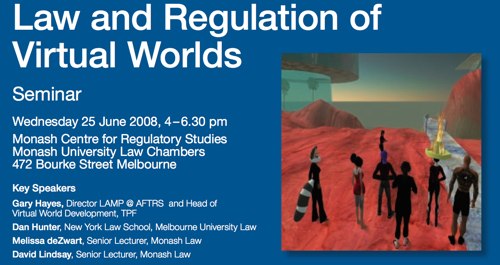
Law and regulation of virtual worlds seminar

Melbourne keeps on churning out interesting virtual worlds events. This time it’s a seminar titled “Law and Regulation of Virtual Worlds”.

The details:

Wednesday 25 June 2008, 4 – 6.30 pm
Monash Centre for Regulatory Studies
Monash University Law Chambers
472 Bourke Street Melbourne

Key Speakers
Gary Hayes, Director LAMP @ AFTRS and Head of Virtual World Development, TPF
Dan Hunter, New York Law School, Melbourne University Law
Melissa deZwart, Senior Lecturer, Monash Law
David Lindsay, Senior Lecturer, Monash Law

This looks like a lively event. We’re in process of organising an interview with Melissa deZwart – watch this space.

Popularity: 5% [?]