Quantcast

Interview – Lee Hopkins, Business Communicator and PhD Student (Part 2)

Continuing on with our discussion (Part 1 can be found here), we discuss brand identity in virtual worlds, get deep into a discussion of virtual world PhD research and talk about governmental cluelessness.
lee_hopkins2

Lowell: One of the more controversial aspects of business in virtual worlds is brand identity. For regular virtual world users, the overt imposition of brand awareness initiatives can cause some backlash. For business there’s a nearly automatic skepticism of the potential for gains combined with a concern for loss of brand control. How do you see this impasse being solved and which companies to date have done the better job in that regard?

Lee: Fabulous question. Next (laughs). Actually, the whole ‘control’ thing is being played out across social media in general, not just SL, as we all know. What was interesting about the corporate entrance into SL and subsequent backlash was that the corporates just believed that ‘if you build it they will come’, which of course we know just doesn’t work in this new era. When you are the only player in town – the only newspaper, the only tv station, the only record company – there is little choice but for people to come to you, but these days YouTube has usurped TV, iTunes has usurped the record company and many bloggers have audiences far bigger than even the ‘big’ newspaper empires. So these days it is a question of, as Janet Jackson famously sang a couple of decades ago, “What have you done for me lately?”

We are all tuned into radio WIIFM (What’s In It For Me) and unless I can add value to your life you are highly unlikely to pay me any attention. Having said that, I am aware that we are culturally empowered to take that view. I’ve just finished reading Gladwell’s ‘Outliers’, where he points out that many cultures have less ‘open’ relationships to authority. Some cultures are very hierarchical and reverent, and so the mindset that we enjoy in the West, where freedom to challenge authority and demand ‘a fair suck of the savaloy’ is not a globally-shared mindset.

The challenge that corporations face when considering any sort of social media initiative is the thorny question of ‘ROI’. For years, any investment of time or resources by a company has needed to be measured against financial yardsticks to see if the reward is worth it. But social media itself is about relationships, not immediate sales or column inches in the business press, and so measuring the true influence of social media can be tricky, with lots of arguments from both sides of the fence.

We can measure largely inconsequential things, like visitor numbers, repeat traffic, keyword analysis, and so on, but the longer-term relationship nature of social media defies such simplistic pigeon-holes. A more nuanced approach needs to be taken, looking at not only how many people have visited but *what they thought*; not only who is talking about us but *what they are saying* and if what they are saying is positive or negative. We need to consider how influential those who talk about us are in their own communities.

All of this content analysis requires time and resource, for which the pure ‘numbers-focused’ senior management teams and boards have scant regard. But slowly that is changing, in the same way that the climate is changing: inch by inch but getting ever-so-slowly faster and faster.

Companies that are ‘doing it right’ are those who are wise enough to not treat their virtual world markets as comprising a bunch of socially-inept idiots but, as decades of academic research has proven, socially-skilled, highly-networked early adopters. In Second Life’s case we could argue some psychographics as a result of the published demographics Linden Lab releases. Start here for a great place to begin your journey into the adoption of innovation

Here’s my take on the average Second Lifer:

One – they are intelligent, because you have to be to be able to learn how to navigate your avatar around the world. I would hazard a guess and say that they are more likely to have finished high school and perhaps also have completed, be undertaking or are contemplating tertiary studies.

Two – they have strong characteristics of patience and perseverance, because if you had a short attention span or limited patience you’d never get past the bloody Orientation Island!

Three – they are time-rich, because they spend an average of 50 hours a month in-world.

Four – they are cash-rich, because to get the best experience from SL you need a fast broadband connection, a fast computer and a powerful graphics card, none of which are cheap.

All of these would suggest that the average Aussie battler, with two kids and a mortgage and a poorly-paid job, is unlikely to be a dedicated Second Lifer. That is *not* a blanket generalisation, but it is less likely that such an individual would have the time and money freedom to engage in Second Life for so long without detriment to their immediate social relations.

Now, as for the companies that *are* doing it right, you could number them in several ways. Obviously there are the IBMs and Sun Microsystems and their like, who use Second Life as test beds for their own customer service initiatives, for meeting places and so on. I know of one IBMer who mentioned that each year around nine man years of productivity were saved by holding meetings in Second Life or other virtual worlds, rather than hang around waiting for teleconferences and webinars to start and finish and being unproductive in those five-minute periods.

Microsoft also announced that it was making significant savings by holding product launches in-world; once the initial design and build costs of the virtual space were paid for, all subsequent launches were practically free. When it comes to smaller, lesser known enterprises, then I guess I must point to my ‘other’ industry – academia – as it is the one with which I have most recently engaged.

I recently attended the second Australian Virtual Worlds Workshop in Melbourne and was stunned by the number of academics who were keenly interested in virtual world developments. It was slightly disconcerting and incongruous to see those who – when I was at high school I would have labelled ancient, decrepit and clothed from op-shop rejects – being passionate about a technology that by rights only ‘young-uns’ should be into ☺. The fact that I am now one of those ancient and decrepit people has nothing to do with it! (laughs)

The take-up of virtual world technology in order to find new ways of reaching out to children is surprising and to me really encouraging about the state of innovation in the day-care system we call ‘primary and secondary education’. But it is not just primary and secondary educational establishments who are engaging with the 3D virtual world, of course – major tertiary institutions are also using the space for traditional and non-traditional work, for research and for skills-based training. As you would know, the training of nursing staff in important life-risking procedures and practices is something that usually cannot be undertaken (sorry for the pun) on ‘live’ patients. Having a virtual patient to practice on is invaluable.

I am looking forward to working with some organisations on helping less-able bodied individuals develop entrepreneurial skills, principally through designing and launching their own businesses in Second Life (or another platform if a better one comes along).

I’m also going to begin researching the whole social media environment to see if academia can make better day-to-day use of it. Both projects begin early in 2009.

Lowell: Which leads nicely to the fact you’re currently doing a PhD – can you describe the overall topic of your research?

Lee: My research started a couple of years ago and has progressed much, much slower than I either anticipated or would have preferred.

I began with the idea of taking two SMEs (Small to Medium sized Enterprises) into Second Life, working with them through the marketing and philosophical issues about whether they should be there or not before, if acceptable to them, helping them ‘go into’ the space. I wanted to see if there *was* any value for SMEs in the virtual space. Although I believed there was, I wanted to put ‘real business numbers’ around my intuitions.

Alas, my innovative and principal contact at one SME left the company and the company itself had no interest in pursuing the research; the other company found its real world business ‘take off’ so that it had no time or space to consider a virtual environment – all hands were needed ‘on deck’ to cope with the sudden surge of interest globally for their product.

So for a long while I have twiddled my thumbs, read lots, written far too little, and annoyed my supervisors by not handing up potential drafts of academic papers for publication.

But with the new projects coming along early next year all should move along at a far more cracking pace…

Lowell: What methodological approach are you taking for your doctorate?

Lee: This is where I get to talk all ‘academic’-like ☺.

I am using an auto-ethnographical approach based on Kozinet’s idea of ‘Netnography’ and which I have taken one stage further and labelled ‘Autoethnetnography’ (see this and this for more background). The idea is that I not only spend my time in-world, but that I document my time, my feelings and thoughts (the ‘autoethnographic’ component) online (the ‘net’ component).

However, I have yet to completely decide on my methodological approach for the two projects next year – ‘The Exciting Adventures of Penny and Isabella’ will figure into it somehow! ☺

Lowell: How easy have you found it to review the literature on the area given its relative infancy as a research topic?

Lee: Second Life itself is a growing area of research, but its antecedents have a long history in the man-machine interaction landscape. Remember that Sherry Turkle was talking about the psychology and sociology of life in a virtual world a couple of decades ago, so too was Howard Rheingold. Add in the ‘traditional’ virtual reality literature on haptic interfaces (‘sex gloves’ as we probably most think of those early experimenters) and you have a literature that starts to become quite ‘weighty’.

If you then add in any of the business literature, such as marketing, marketing psychology, public relations, branding, inter alia and you start to become overwhelmed with choice.

Whereas two years ago ‘Second Life’ as a search term returned little result in the academic search engines, nowadays that body of literature is growing at a cracking pace.

lee_hopkins3

Lowell: Moving beyond Second Life, what virtual worlds have caught your interest recently?

Lee:Twinity looks interesting, as does VastPark. Sun’s Wonderland platform is, of course, worth watching and I have no doubt that Roo Reynolds and his fellow metaversian rascals at IBM have something up their sleeve ☺ I was recently taken with how simple ExitReality is but how visually powerful it could be. Of course, ExitReality and VastPark are good ol’ Aussie innovations, so it’s nice to be able to talk about something great that *hasn’t* come out of the sun-drenched plains and hills of San Francisco.

I have a *very* strong suspicion, a belief if you like, that Second Life will not be the ‘killer app’ it would like to be. I remember the early days of the web when the company I worked for, Digital, owned and ran ‘AltaVista’. It was the number one search engine around and nothing was ever going to replace it.

Of course, along came Yahoo! and ‘AltaVista’ joined the ranks of ‘Whatever happened to…’. Naturally, we all knew that *nothing* would ever knock Yahoo! off the top perch of the search world, you could guarantee it. So along came two Stanford programmers and a couple of their mates and the rest is history, as they say.

So I strongly believe that something will come out of ‘left field’ and knock Second Life for six, while at the same time bringing scalability and simplicity of use to the masses. And if anyone has a time machine that could put me forward five years to see who ‘won the race’, then allow me to return so I could invest in them, I’ll be your best friend! ☺

Equally, if anyone has a time machine that can transport me back to the early 1980s so I can pick up some cheap Microsoft and Apple stock, then bring me back to the here and now, I’ll reward you with a few thousand shares in them.

Lowell: In the Australian context there’s still a fairly low adoption rate by business of virtual worlds – what do you see emerging as the game-changers that will provide some more momentum?

Lee: Nothing at the moment, I’m afraid. I spend a lot of time talking with businesses about social media, which is still a long way from their thinking but they are slowly beginning to understand that they need to pay attention to it. Second Life and 3D virtual worlds are so far off their radar as to not even be blips.

Even though Australians as individuals are recognised worldwide as important early adopters — and Forrester’s latest report, ‘Australian Adult Social Technographics Revealed’ asserts that Australia is the perfect launch pad for global brands launching social media initiatives, to which I agree. We can see this when we look at Second Life’s demographics (we are 52nd in the real world population ranks, yet 11th in Second Life, showing that we are ‘punching well above our weight’), the business community in Australia is highly conservative. Add into the mix the reality that most CEOs are ex CFOs (Chief Financial Officers, aka ‘bean counters’) and we see a business environment where fiscal economics are the determinants of business strategy, not environmental nor human economics.

I don’t forsee any takeup by corporate Australia of virtual worlds any time soon, not until the marketplace is demanding it and their competitors are doing it and showing some success. It never ceases to frustrate yet at the same time greatly amuse me that Australian businesses love to talk about ‘competitive advantage’ yet never actually want to do anything to give them it ‘until others are showing that it works’.

Lowell: Educators have led the way with virtual worlds. What’s inspired you in the education sphere?

Lee: The work of Jokay Wollongong and Lindy McKeown in particular stand out here. They are pushing the envelope of what academically can be done with 3D virtual worlds. Being around them, even virtually, is intimidating – what they have achieved, what they are doing, where they are going… all is phenomenally impressive and make me feel like a complete slacker! ☺

Lowell Cremorne: Can you name the presences in Second Life you keep coming back to?

Lee: Sure, but bear in mind that often I don’t visit these places for a month and they’ve moved location, which is really frustrating. It would be nice of SL automatically updated one’s SLURL picks, but that may be a database too far.

I most often frequent my own two properties, the beach hut retreat of the Better Communication Results empire or the Better Communication Results office. Otherwise:

ABC Island
Dedric Mauriac’s shop – great tools
Hydro Homes – great offices and houses
Market Truths – great research on SL
Just for Him – men’s clothing and accessories
Crucial Creations – great Italian design work for female shoes in particular, but clothing in general
Influence Hair – the best hair for women in SL, IMHO
ALady Island – absolutely gorgeous female skins
Lindy McKeown (aka Decka Mah)’s teaching and action research island in SL

Lowell: Prediction time – what do you believe will happen in virtual worlds over the coming year?

Lee: The revolt against Second Life will continue, in that landowners will increasingly be less likely to pay for increases in land rental, especially since other, cheaper alternatives will become more plentiful. Additionally, the lack of scalability of Second Life will start to bite harder. Again, I hold to my prediction that someone will bring something out of left field, so we will all have our breath taken away by its simplicity.

But the learning we have all undergone in Second Life will not be wasted, not in the slightest. Part of my reasoning to companies for becoming involved with virtual worlds like Second Life is based on history: we thought we could take the ‘language’ of print and put it on the web yet technology (dial up, online reading styles, for example) showed that we had to adapt our communication styles to fit this new media. So too with 3D virtual worlds; we cannot just take the existing communication paradigms of the 2D online world and expect them to work equally well in the 3D environment – we need to take into account the spatial environment and visual and non-verbal characteristics of the other ‘players’ in the conversation and of those who are adjacent to us.

We have barely begun to figure out how to communicate effectively in this new communication landscape that allows everyone to own their own tv station, their own radio station, their own newspaper and magazine… we are some considerable way off from learning how to communicate effectively when you add in individual- and machine-controlled movement, three dimensionality and non-verbal, non-textual clues into the mix!

Lowell: Back to Australia again, what’s your take on our Federal Government’s grasp of social media more broadly, and virtual worlds more specifically.

Lee: There is a great movie that encapsulates it all in just one word: “Clueless”.

Bless ‘em, they are trying, but Governments are driven by politicians who look for short-term gains to keep themselves in positions of power, not technocrats and innovators who look to the longer-term for societal gain.

Change will, as always, be driven by the zealots, the ranters, the ravers, the ungentlemanly shouters from rooftops, the inconsiderate individuals who refuse to take a relentless and increasingly strident and often-times dismissive ‘No!’ for an answer.

Interview – Lee Hopkins, Business Communicator and PhD Student (Part 1)

Lee Hopkins is one of Australia’s more high profile Second Life residents who makes a living talking and consulting on social media and business communication strategy. On top of that, Lee’s immersed in completing a PhD with a virtual world focus, so I took the opportunity to nail Lee down for an interview.

leehopkins

Lowell: Lee, you’re best known for your consultancy work in regard to social media – is that what led you to explore Second Life initially?

Lee: It all started with Shel Holtz (a business communication expert from North America) mentioning it on ‘For Immediate Release’, the industry podcast for business communicators. He and several others became excited about the arrival of yet another channel of communication that the corporate world had to get its collective head around. This was all about two years after blogging just started to get going, so I am guessing around 2006 was when Second Life came across my radar.

Shel and his podcasting colleague Neville Hobson had been right about the growing importance of blogging and then podcasting, so I figured I’d grant them a ‘three out of three’ about Second Life as well. I joined up and started developing my own experiences and understanding of it as a direct result of them.

Lowell: Can you recall that first experience with SL? Did it click for you right away or did the infamous orientation experience put you off?

Lee: That first experience was a nightmare. Let’s not forget that this is Australia, so our broadband is a lot worse than our North American, European and even Asian friends enjoy. It was slow, my computer’s graphics card was struggling, I didn’t understand why no matter how far I flew, land kept being built and populated in front of me faster than I could stop and buy it.

And Orientation Island! Argghh! I reckon it’s actually gotten worse, not better. I had no other virtual world to compare it to, not being a gamer or anything like that, but I don’t recall being frustrated by it. Well, not *overly* frustrated, anyway. It was such a new experience, and the interface so slow and clunky, that I must have found *something* worthwhile enough to make me stay. Probably its novelty for me.

Lowell: What in SL led you to become a long-term user?

Lee: Goodness, that makes me sound like a heroin addict! (laughs) – “Second Life becomes my home”, confesses 50-year old cracker. I guess that I became convinced of the power of 3D virtual worlds to bypass some of the normal ‘static’ and reach out in new ways to people. That sounds confusing, so let me give you an example:

My wife is a nurse and, let it be understood, considers the computer the spawn of the Devil. She hates them with a passion only reserved for me when I do something wrong (you know, like when I breath or something – every husband reading this will understand). She resents the amount of time I spend ‘playing’ (as she calls it) on my computer rather than doing something useful – and this is before we even start talking about Second Life, and remembering that I don’t play computer games. For me, the PC is about work and networking with colleagues around the globe.

Yet, when I showed her Second Life (albeit a movie on YouTube about it) she instantly understood and said, “I can see how this would be perfect for business and the health system”. After I picked up my jaw from the floor and reinserted it, I passed out. On coming to, I asked if I had heard her correctly – the woman who believes the PC is the work of the AntiChrist *instantly* and intuitively saw the value of 3D worlds like Second Life. To this day I still haven’t quite recovered…

As for what keeps me in Second Life, it is a combination of things. One, the belief that the 3D virtual world will grow to be the force that the pundits proclaim it will be, that it will become a part of our everyday web experience within a few short years. Two, and following on from point one, that I need to keep abreast of developments. Not necessarily so that I need to live and breathe it (I have, after all, other work that I need to get done in order to pay the bills), but enough to be able to speak knowledgeably and confidently about Second Life from a business perspective.
Three, that I have discovered parts of myself I never knew I had, or rather have uncovered parts that had lain dormant and only hinted at their presence.

For example, when I was in the RAAF many years ago I was based for a while in Penang, Malaysia. Whilst there I found a great tailor who made clothes to my design for next to nothing. I loved designing clothes, taking what in academia we call a ‘bricolage’ approach – that is, like a magpie, just stealing bits from here and there to make something different than just the sum of the parts. But I had forgotten about all that shortly after returning to Australia, where cheap tailors and fabrics were not so easily accessible as they were on the streets of Penang in the mid Eighties. So when I found the vast array of clothes to be had in Second Life, my love of clothing re-emerged and I said to myself, in the words of a great quiz show, “Let’s go shopping!”

Let me whisk back to my childhood. One of my favourite toys was ‘Action Man’; not today’s ‘only does one thing and so you need to buy loads of them’ rubber toy, but a UK version of ‘GI Joe’ where you only needed the one figure but could buy loads of different outfits and accessories – guns, tanks, planes, helicopters, knives, grenades, mortars, etc. – to help you live out your boyish killing and war fantasies. Fast forward to today and in Second Life you can have the one ‘toy’ that you can kit out with all manner of accoutrements – my personal favourite hobby at the moment is looking like the robot from that seminal 1970s show ‘Lost In Space’, complete with “Danger, Danger, Will Robinson!” voice. I also found a ready and easy way to create my own adult Barbie and, like many males in Second Life I’m sure, created female alts and dressed them in skins and clothing that our ideal lovers would look like and wear.

lee_hopkins1

Now, I also combined my female alts into my business operations. (Steady, boys!). We all know that ‘sex sells’: there is tons of academic research to show that men AND women prefer to look at attractive women than attractive men; the gaze lasts longer, and so on. We also know that beautiful people in general are more likely to be attributed as honest, trustworthy, smarter, faster, harder working, and so on. The reasons why are for another day, but the shocking truth is that the beautiful people are given luxuries and access that we ‘common folk’ can only dream of. So I created my two female alts to be my in-world business representatives. By hooking them up with MyCyberTwin.com’s fabulous and comprehensively pre-scripted artificial intelligence engine, and attaching an ‘anti-idle’ script to the alts, and then making a cup of *really* hot tea, I can be fast asleep and my two alts can be in-world, talking with other avatars and generally being my Customer Service Representatives, even while admitting in their profiles that they are mere robots.

They will also soon appear in a comic series, ‘The Exciting Adventures of Penny and Isabella’, the first issue of which will hopefully be published in three days’ time. I don’t want to give the plot away, but in essence the girls and I are a business communications consultancy that solves real business issues through the power of social media.

The final, and arguably most important reason, why I stay in Second Life is that my PhD is focusing on it, but you’ll no doubt ask me about that in a minute…

Lowell: To some the social media link to virtual worlds is intrinsic. To the broader public though, how would you explain the power of virtual worlds from a social media viewpoint?

Lee: If one accepts that social media is all about the new-found technologically-empowered individual able to engage globally in conversation and dialogue with others of similar interests and passions, then the 3D virtual world is a mere extension of that.

Instead of an often non-linear and time-interrupted conversation that occurs, say, over an email exchange, the technology of social media allows us the choice to engage either in real-time conversations or time-interrupted ones. It also allows us to choose between text, vision, audio or any combination of them. In addition, it allows us to enjoy that conversation either in a one-to-one, one-to-many, many-to-many or many-to-one mode. 3D virtual worlds like Second Life allow us to take that freedom one step further and inject aspects of our personality into the stream, through our sense of dress, or the environment we prefer to be seen in, our real or imagined gender, and so on.

We also have the freedom (and with it the responsibility to safeguard that freedom) to say what we think – which means calling someone a ‘tosser’ for having adult-lingerie Barbies if you want.

Click here for Part 2 of the interview (this will be available from 9am AEST on the 18th December 2008)

Interview – Nathan Organ (AUGrid)

Back in February this year we interviewed Steve Sima, founder of the Openlife grid. Since then another Australian has set up a grid based on the Open Simulator architecture. This one is called AUGrid and has been set up by Norgan Torok (RL: Nathan Organ) and we caught up with him for an interview this week.

Lowell: Can you tell me a little about your background and how you got into virtual
worlds?

Norgan: I discovered Second Life around a year ago, after resisting for a while I finally logged in and started exploring. I found it fascinating but had to look into this “game”and work out just what it was about. After realising quickly just how great and diverse the culture and people in
there were I had to explore more. As with most things i encounter I looked deeper and deeper into it. Until the interoperability announcement I considered SL a closed system. The interop test showed me the light into OpenSim and its great possibilities.
.

Lowell: What was the impetus for you setting up AUGrid?

Norgan: Two things inspired me to do AUGrid. Firstly, the interoperability of OpenSim and Second Life opening up that user base to a wider world of virtual worlds. There was concern that Linden Lab would make Second Life a closed world for a while there. Secondly, my own work supporting 1000 hours for autistic kids and my work with EnGeneIC who develop novel cancer treatments, and my
yearning to help support these admirable causes. AUGrid is focused on providing exposure and services to these causes as well as the education sector.

Lowell: Are you personally hosting the grid or working in conjunction with
others?

Norgan: For the moment i am personally paying for co-located servers, with a view to reselling regions servers to help bring money back into the project. Reactiongrid have been helping with supply of cost effective servers to run the grid on. My training and experience in network design and operation helps me manage the topology of the grid servers and plan for growth. We also get support form various developers and sub-communities within the OpenSim project and in return I share my knowledge and experience in networking and my work in OpenSim with the community at large. AUGrid has also set up its own dedicated PayPal account to more easily manage any donations or funds coming in. With
these funds I hope to bring in extra resources to help expand the project and donate services to schools and charities.

Lowell: How far along the development path is AUGrid?

Norgan: AUGrid follows the core development path of OpenSim. I have been busy
talking with the core development teams and some people from Microsoft who have been helping AUGrid along with feedback, advice and techniques. This project and many others on OpenSim are a 2-way development structure where the users and various groups contribute to each other and the common code. This is how I am able to setup AUGrid confident in the fact that the OpenSim community is there to help as am I to help them. As I mentioned before I try to keep the
code quite new, which can bring in new bugs and cause some down time but also pick up the improvements as they are developed.

Lowell: Compared to say Second Life, what would a new resident see on your
grid? Is it a similar experience at this stage?

Norgan: The experience is quiet similar to Second life for general navigation and user experience, in fact you use the SL viewer in many cases to log into AUGrid. There are also other viewers with extra features like building higher height and megaprims allowed. The LLFunctions script
implementations are two-thirds the way through with new ones being added every day, so the scripting and building environment is similar also. The real difference is the flexibility on the server side. For example, we can play with gravity and I have setup an experimental sim that has moon gravity; but really that’s just the start. With some projects using RL integration of robots and information fed in from hardware and external databases, the possibilities are almost endless. This is
the real power of the OpenSim platform – using a modulated approach to the code design, you can create and integrate your own modules on the server. An example of some of AUGrid’s technology is the data center that monitors RL servers in real time. It actually pointed out a problem with one of my DNS servers which I was able to investigate and correct as a direct result of seeing the server in-world.

Lowell: What have been some of the biggest challenges to date with the grid’s
development?

Norgan: Biggest hurdle is the code management and avoiding downtime. Rapid development code is always a task to handle but for the most part the core systems are very stable. We try to explain and notify of any bugs and issues as they asrise and why there was any downtime to help the
users understand how the system works and just how quickly things can change.

Lowell: What are you plans for AUGrid in the coming 6-12 months?

Norgan: To expand the grid onto more servers, which is why we have started taking donations, and allow a more powerful grid for better in-world experiences. The topology of
AUGrid is designed in such a way that it can be easily scaled up and this has been done because i have grand visions for AUGrid. Aside from the obvious expansion of the grid the biggest thing will be to provide free or low cost regions to educational and medical projects, allowing them a powerful platform on which to teach and learn. Ideally, the grid will pay for itself and allow donations of regions to schools and charities.

We have started toying with the idea of medical and education hubs and once we acquire more servers i will be setting these up so when users visit in-world they may more easily get to those areas and projects they are interested in.

Lowell: What differentiating factor do you believe you have over other grids, including Australian ones like Openlife?

Norgan: The differing factor is AUGrid’s primary focus on real life support of charities and good causes and it’s non-profit business model. As well as a true aussie flavour while travelling around the grid with many and varied parts of aussie culture on show. Triple X Industries sim is
a great example with an Aussie pub and amazing aussie shop fronts and areas. This is one of the big helpers to establishing AUGrid’s content – I don’t know what I’d do without him. We also have an accurate representation of Brisbane’s Southbank with much more coming along.

Lowell: For people wanting to check out AUGrid, how do they best do that?

Norgan: Thanks to TheCritic we have an SL Launcher that can be downloaded from a
link on www.augrid.org. It works for Windows, Linux and Mac and allows the user to quite easily launch their existing SL Viewer to connect to AUgrid, among others. There is also a Hippo Viewer made for OpenSim that with a quick shortcut modification can be used on AUGrid allowing the extra features like higher build height limits and larger prim sizes.

Interview – David Rolston, Forterra CEO

Forterra Inc is a private virtual world provider with a focus on health care, education and homeland security / disaster preparedness. One of their press releases a few weeks back caught my eye – Forterra has been awarded a Commercialization Pilot Program (CPP) by the US Army for medical training simulations of combat scenarios. So I thought I’d have a chat with Forterra’s CEO David Rolston (via email) about Forterra’s take on virtual worlds.

Lowell:: Can you describe a little of Forterra’s history and whether virtual worlds have always been its focus?

David:: Forterra has been around for a decade already. Initially the company was
known as There.com, and made one of the first social interaction websites (which still exists as There.com). About two and a half years ago There.com made an important change. Our board decided there were promising opportunities in other areas. We spun off a company called Makena Technologies that was licensed to work in the entertainment area, applying the software to creating social worlds for MTV, Coca-Cola and other consumer environments. At the same time we redirected the mainline company to work on enterprise applications and other professional usage, and renamed it Forterra Systems.

Lowell:: For those who haven’t heard of OLIVE, can you give a little of its development history?

David:: As a starting point for the new company, Forterra took the existing software which was built to execute 24 hours a day, seven days a week with millions of users. The software was used very heavily in large-scale, multi-player environments, but it was there for a specific task, namely running There.com. So our first job was to extract a reusable platform from that which would allow a customer to quickly build an enterprise oriented virtual world. That platform is now Forterra’s flagship product OLIVE (On-Line Interactive Virtual Environment). Applications developed using OLIVE allow users to sit at their PCs with a network connection, log on, and appear in an interactive, virtual environment represented as a fully animated avatar. We have the best 3D audio in the industry and have been told by our customers it sounds just like being in a real meeting. Through a choice of simple keyboard, mouse or game controller interface, users are able to navigate through realistic environments, access and deploy equipment, drive/fly vehicles, don personal protective equipment, and communicate with one another. As a scenario is executed, the results are captured by a built in session replay system that support debrief, so users can learn from the simulation exercise.

OLIVE’s distributed client-server architecture enables simulations to easily scale from single user applications to large scale simulated environments supporting many thousands of concurrent users. Working with the OLIVE platform, customers can create realistic virtual world content and plug-in functionality to meet a wide range of simulation needs. An API layer enables customers to reuse existing content, integrate with third party applications, and leverage third party tools. The open
nature of the OLIVE platform allows customers to create powerful multi-resolution and multi-fidelity federated simulation environments.

Lowell:: Is the user interface similar to other virtual world platforms like Second Life?

David:: There are some similarities between the OLIVE user interface and that of Second Life in large part because some of the features and navigation are similar. We find Second Life users are comfortable navigating and communicating in OLIVE within about 10 minutes because of these
similarities.

Lowell:: There are also some graphical similarities to Second Life – does OLIVE have any code that’s similar?

David:: No there is no code that is common or similar between OLIVE to Second Life. The graphical level of OLIVE is more realistic and business oriented then Second Life in large part because the majority of our 3D content has been professionally developed.

Lowell:: You’ve recently announced that you’ve been awarded a Commercialization Pilot by the US Army for medical training simulations of combat scenarios – can you explain a little more about that?

David:: The initial Small Business Innovation Research (SBIR) awards that were granted to Forterra by the US Army have been very successful. We have successfully demonstrated our technology through a phase I and II award, and as a result have been awarded a Commercialization Pilot Program. This program funds the development of features so the software can be used in Army production usage and in the commercial markets. Using the OLIVE platform we developed an application with realistic virtual emergency departments, operating rooms, reception areas, and even entire health-care facilities have been built to support a wide range of training applications, including first responder and trauma training. In the U.S. military, the contemporary operating environment requires combat medics to use their skills in team-based medical combat scenarios for effectively treating trauma patients on the battlefield.

Lowell:: Do you have plans for OLIVE to ever be interoperable with other platforms?

David:: Absolutely. The first level of interoperability we have achieved already is for 3D content to be imported or exported to OLIVE using standard content file formats like Collada. We have several partners who are able to migrate their Second Life content and import it into OLIVE. The next levels of interoperability will include how avatars and even the client software will be interoperable between virtual world platforms, but these two are more in the future.

Lowell:: What sort of technology do people need to use OLIVE?

David:: Today we have a PC only client that runs on either XP or Vista. Our customers are enterprises which have overwhelmingly adopted PCs as their main compute platform for users. However Forterra is working on support for lower end PCs since a typical deployment must run on laptops or desktops that are 1 to 3 years old. We also have excellent support working behind or through firewalls so enterprise IT groups can control who gets access to the virtual world.

Lowell:: What do you see as the key benefits of virtual world-based training?

David:: There are many benefits. First geographically distributed learners can meet virtually for either individual or team training and practice their skills many times before applying them in the real world. For certain types of jobs such as being a soldier or oil rig worker our software saves lives because of the hazards of their jobs. For other jobs such as a sales person the skills and confidence they gain practicing before applying their craft on real customers makes them more effective. Second, OLIVE includes 3D record and replay so teams can conduct after action reviews to pinpoint where learners should improve their performance. Lastly, with the physics and simulations built into OLIVE we can enable interaction with objects that supports a wide range of support and manufacturing type of training around a product or process.

Lowell:: What does OLIVE cost? Is it a scenario-specific cost or can people purchase the software and create their own scenarios?

David:: We offer a Software Development Kit that allows customers or partners to develop their own scenarios. Forterra offers three types of developer programs that include a developer license to OLIVE, documentation, support, and different levels of training and developer services. We
offer a Basic and Enterprise production license to OLIVE that allows small groups to deploy inexpensively with the ability to scale up to 1000s of concurrent users. We offer the option to license industry specific pre-packaged content packs such as a medical and meeting pack as well as plug-ins to standard business systems or integrations. These content packs and plug-ins help customers get into production more quickly and less expensively but with the ability to develop on top of those offerings to meet specific needs.

Lowell:: What plans for future developments does Forterra have?

David:: There are several exciting development areas we are working on. First we have rolled out a virtual collaboration application that shares MS Powerpoint, streaming video, and SCORM elearning content to distributed audiences. Later this summer we will expand the collaboration suite to include any MS Office document type, white boards, and meeting management. We are also wrapping up a new terrain standard we pioneered called Paged Terrain Format that allows importing any legacy terrain database. Later this year we will support extensions of our API for AI middleware vendors so we can provide voice recognition and responses with NPCs. This supports high volume individual training scenarios.

Interview – Skribe Forti

Skribe Forti is an Australian Second Life resident who’s got an established track record in machinima that we’ve covered previously. Last week we finally caught up with Skribe to talk a little more about the power of machinima.

Lowell: Can you give a potted history of your involvement with Second Life and more broadly your historical online life?

Skribe: I’ve been in SL since Jun 2006 and technically I’ve had a net presence since 93, but I’ve been mucking around on MU*s and BBS since 82-83.

Lowell: Can you also give a brief overview of your involvement with film production?

Skribe: I’ve been making films since I was 8yo. Before that I used to star. Dad was a home-movie buff =). I then worked as kid on some of the local tv productions both in front and behind the camera. That was when we used to make stuff in Perth. I went to uni, did film and writing there, and soon after graduating started my own business.

Lowell: What led to your passion for machinima?

Skribe: The fact that it is the best of both worlds: live-action and animation. You can inspire the performances from your actors like in live-action, as well as tell the range of stories you can in animation. And it is comparatively cheap compared to both.

Lowell: Can you give a basic run through of your creative process when creating a piece?

Skribe: For live action I storyboard like crazy because it’s an easy way to demonstrate to cast and crew what you need. With machinima I rarely storyboard. I find it too limiting. I know what I need from a scene and I like to be able to experiment to find the best way to achieve that. It’s very easy to experiment in machinima. Much harder with live-action or even animation because of the numbers of people – and budgets – involved.

Lowell: Do you work in any other virtual worlds beside Second Life and if you do, which ones?

Skribe: I have, but unfortunately I’m unable to reveal which ones.

Lowell: How do you perceive the role virtual worlds play in your overall life – are they a dominant aspect, a ‘work role’ aspect or just a minor part?

Skribe: Almost purely work, but I occasionally socialise too. I have a great group of virtual friends and enjoy chatting when I’m able.

Lowell: Do you find you come into conflict with other people in-world? And if so, why and how do you deal with it?

Skribe: Not generally. We had a griefer on set once who started hassling the lead actress. I hear he’s still in orbit =).

Lowell: One of our regular questions: three locations in Second Life that you keep coming back to?

Skribe: Conference Island, Alt7 and Greenies.

Lowell: You’ve done quite a bit of work with business – have you met much resistance to the idea of business in virtual worlds from those you approach?

Skribe: Definitely, but there was resistance to the internet initially too. I remember being told back in 94 that nobody would make a cent off the internet. Business is always conservative. It is after all their money. The owners aren’t in it for charity. They want to see hard results ending in fat wads of cash – preferably in their own pockets. What we do in virtual worlds is new and more than a little weird to most so there is bound to be some reticence. But as more genuine success stories emerge, as hard data showing the real benefits are revealed, business will start to embrace VWs. It’s only a matter of time. It’s too valuable a tool.

Lowell: How much of the work you do is coming from Second Life?

Skribe: Most of it. We still do occasional work in other worlds, and we still have clients coming to us for real-world projects, but most of our focus is on Second Life because that is where our client base is.

Lowell: What current projects do you have underway?

Skribe: I have just finished a video tour for a development and media company based in NYC and we’re working on 2 sets of viral videos.

Lowell: What are your plans for the next 12 months?

Skribe: Get monumentally rich. Not die.

Lowell: Any chance of a feature-length machinima?

Skribe: Find someone that is willing to make that sort of investment and a feature-length piece is always a possibility. We have enough stories we want to tell. Finding the funding is always the hard part.

Lowell: Who inspires you in Second Life?

Skribe: My wife. She always finds the best and weirdest stuff.

Lowell: What frustrates you the most about Second Life?

Skribe: The instability. Both with the platform and the management. I can usually deal with the platform problems – it’s new and that is to be expected. It is also better than when I started. The management is a much more difficult problem. There are too many kneejerk reactions to be entirely secure that you aren’t going to wake up in the morning and discover that your business is now banned. While I agree with the Linden Lab decision on gambling, for instance, I found the process unsettling. It came out of nowhere and there’s a small part of my brain that says, ‘it could happen to you’.

Lowell: What are your thoughts on whether there’s an ‘Australian community’ in Second Life?

Skribe: There seems to be but I’m not overly knowledgeable about it.

Lowell: The Telstra presence in Second Life has had a lot of success – why do you think that is?

Skribe: They grok what SL is about. It’s a marketing tool and whoever is the brains behind their project really knows how to make the most of it. The only problem I have with it is the build itself. There’s too much crud and the overall look is hokey. It also has too many breast domes – but maybe that is just me.

Lowell: And ABC Island – what would your critique of it be?

Skribe: No plan. No action. No chance. For a more in-depth critique check out my comments here on The Metaverse Journal or my blog.

V2: Synner Prinz and Bill Hayabusa

As promised a few weeks back, we’re pleased to start a new feature called V2 (virtual two), where two avatars describe their relationship in their own words. The inaugural edition features Australia-based Synner Prinz and US-based Bill Hayabusa:

Synner Prinz

It’s with pleasure I share my journey thru Secondlife with my love….

I’d only been on Second Life a few weeks when I was walking along a jetty and saw this guy swimming around. ‘Wow’, I thought to myself, ‘that is so cool, you can even swim here’. And with that, I jumped in…. ‘hmmmmm, why am I sinking to the bottom of the sea’ I ask myself as I turn a bright shade of red! I make it back to the jetty after much splashing and near drowning and am relieved my silly newbie antics haven’t scared him off….That was the day the most awesome journey began for my love Bill Hayabusa and me, Synner Prinz.

I don’t recall when I lost my heart to him… was it when he took me horse riding on the beach and I held onto him so tightly? Was it when he took me surfing and we splashed, played and laughed together? Was it when he danced with me under the stars and made my heart race and body tingle all over? Or was it the day when the sun was setting and he held me in his arms on ‘Soul’ declaring his love and giving me his heart?

I really don’t know, but what I do know is that through our amazing adventure on Second Life we have been able to share the joys and experiences together such as horse riding, surfing, dancing, motor bike riding, skiing, ballooning, parachuting, ice skating, moutain bike riding, shopping, roller skating, dining, boating, diving, flying, travelled on a spaceship, roleplaying in a 1800′s mid western sim where we married by common law. We’ve lived in a cabin, a castle and now a mansion…. how do you top off a year like that? You renew your wedding vows!!!.

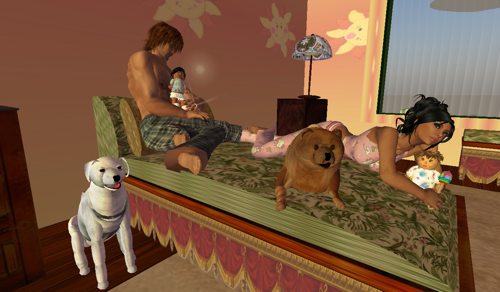
What are we doing now? Basking in love and living as a family with our two dogs in our house with the white picket fence awaiting the arrival of our twins…. nice huh :) You really can live your dreams here and I never want this fairytale to end!
Bill Hayabusa

Heard about Second Life on CNN so came to do some research on social engineering for a small educational company. The idea was to motivate and guide students to excel in public speaking. The potential to improve peoples’ lives is impressive. What I found came as a total surprise. I found that if you allow yourself to become your avatar, you could live vicariously, the life you always wanted. This in turn produces a feeling of accomplishment and happiness never experienced before.

Found love… I was exploring all that can be done in SL, like swimming. The animation and control was impressing me when there she was… A vision of the woman I always wanted for a wife… to spend all my days and nights with. From the moment I saw her (knowing “this is a game… not real”) I fell deeply in love with my dream. Then after a few words, I knew what I wanted… I wanted it to be as real as real can be. I realized it’s the experience that matters most, and wanted to experience this new feeling of love, that I never was able to experience in real life.

Got married…I was role playing a US Marshal in 1897 Tombstone Arizona. I asked Synner to be my common law wife and she accepted. My heart sang and I felt young and full of life. Something I hadn’t felt in years. I thought those feelings I’d remember fondly, but never experience again.
Created a family….. One year later we got married/partnered with a complete wedding at our home we built and friends we had acquired in SL. Then we got the great news of us having twins.
From meeting each other, falling in love, exploring all that SL has to offer, building our dream home, getting married, from conception to the birth of our babies. It’s been a most fantastic experience and now I know beyond a doubt, anything is possible. Like finding your soul mate (grinning/w dimples).

Interview – Sakai Openlife (Openlife founder)

As we reported earlier this week, Openlife is a promising new alternative grid to Second Life. Its founder, Sakai Openlife (RL: Steve Sima) is based in Brisbane and we caught up with him via Openlife’s Live Chat for a discussion on everything Openlife.

openlife1.jpg

Lowell: Sakai – Openlife came out of the blue for me but it’s obviously been a labour of love for you – can you give a potted history of how Openlife came to be?

Sakai: Sure, we kicked things off approximately four months ago and clearly had to do a lot of work to understand a workable solid method to approach it. Number one has always been and will be the Users. So with this in mind it has been quite a colourful ride trying to foster the community together and maintain the best user experience we can with the code available.

Lowell: what made you start this huge undertaking?

Sakai: Well, I’ve had a passion for 3D interactive platforms for ages and my background is IT infrastructure. So to provide a solid platform being feature rich and extensive for different uses is most certainly up my alley. After following the OpenSimulator project for a while I took the decision to make the plunge and start treading the water with the OpenSim Application Platform – Second Life had some big drawbacks for me.

Lowell: I’m assuming you’ve used Second Life extensively prior to this project? What was it about Second Life in particular that you wanted to improve on?

Sakai: Some towards content creation and development of content and some towards the user experience. Second Life itself I see has been hugely popular with its social interaction and it’s a great environment to see this in action. They have been pioneers in this area for years but to have an open source platform where as a company you could develop very feature rich immersive environments and provide them to users is something that Second Life falls short on in my opinion, but the potential for this to happen with the Openlife Grid & OpenSimulator Codebase is very much a possibility.

Lowell: What areas do you specifically see Openlife having advantages in?

Sakai: One thing we are keen to see in the near future is the ability to content create and develop a region on your local environment ie. home PC or workplace network then export that entirely to a published region existing in the Openlife Grid.

Lowell: So, fully offline region-wide content creation?

Sakai: Correct, exciting isn’t it. This can bring in the quality of in-world environments to a whole new level.

Lowell: I can see that would get a lot of people excited – is that option close?

Sakai: Yes it is close, currently we can take the terrain and prims created. Clearly there are other things to bring over such as textures, scripts etc.

Lowell: So for the sake of the potential new user – is Openlife in beta at present or a fully functioning option?

Sakai: No it is not a fully functioning option at the moment. We work closely with, and implement the Opensimulator source code which in itself is only recently version 0.5. However, community interaction and involvement in the Openlife Grid is important as the code moves forward.

Lowell: So is there a roadmap and/or timeline for OpenSimulator and subsequently a fully functional Openlife?

Sakai: With the source code being a community project ‘exact’ timelines can be difficult to adhere to. However, the OpenlifeGrid is at the tip of releasing the Foundation Resident Event, enabling Openlife users to have their own region in-world. The other side of this is that it will help full-time developers to work on the code on a professional level. Naturally, this work is in conjunction with the OpenSimulator effort and is released back to the community.

Lowell: So in regard to Openlife specifically – how many are involved in its development?

Sakai: We currently have two people including myself, but receive invaluable contributions from the Openlife community, making the Openlife Grid very much a community effort.

stevesima.jpg

Lowell: And can you tell me a little about yourself? You’re based in Brisbane?

Sakai: Yes, sunny (but raining a lot lately) Brisvegas. I have a strong history of IT, and a passion for pioneering new technologies.

LLowell: Do you run your own business or are you from the academic side of the IT fence?

Sakai: I do run my own company. But it should be mentioned in regard to the Openlife Grid that there is some university involvement and it’s very much welcomed.

Lowell: Are you able to discuss which universities are involved?

Sakai: Hmm, good Question. I think it may be best that we give them the opportunity to express any involvement through the site, and their own sites.

Lowell: On interoperability – Linden Lab’s release of the SL code has helped get things where they are today but do you have any ongoing communication with Linden Lab in regard to your work?

Sakai: Personally I have only recently had some conversations with Linden Labs at a Finland event in relation to the Openlife Grid. But we are not ‘Anti-Linden’

Lowell: And were they receptive to the work you’re doing?

Sakai: Yes, I believe Linden labs has been fairly receptive of the Openlife Grid and also the OpenSimulator Project. There are even Lindens in the Openlife Grid as
users.

Lowell: So what are your plans over the coming weeks? I’m assuming more sleep isn’t part of it.

Sakai: Wow, sleep I almost forgot that thing. Since we started we have steadily grown to around 6000 users as at a week ago. I’ve been working on this new website which is still being implemented (but online) with the aim to foster and grow the community. But in the weekend past we saw the number of users jump to (as of a few hours ago) 10,000 users.

Lowell: So as of now, what can a new user do in Openlife?

Sakai: Hmm… really it’s a very free environment limited only by the features of the current code level. But there are the natural ones similar to Second Life -meeting new people, making friends, getting involved with Openlife Communities. Building your own creations, and as of tommorrow owning your own regions.

Lowell: So people can log in now and intereact as they would in SL?

Sakai: Correct. You can login with the existing Second Life viewer and interact very much the same as Second Life, with the only limitations being the features that exist in the current code level.

Lowell: Ahhh ok, that was my next question. So there’s no need to download a different viewer?

Sakai: A different viewer is not necessary just a change to the shortcut or you can use a little program on our website to redirect your viewer to the Openlife grid. However, on an exciting note, an alternative viewer will be available very soon. That is in development by the RealXtend team.

Lowell: So if you had to sum up in a sentence or two why people should sign up to the Openlife community, what would you say?

Sakai: Wow, it’s really hard to sum up so short with such a wide community involved. Joining the Openlife Grid community is a chance to be involved in a pioneering new platform where your suggestions and ideas are very welcome, your feedback is important, and your participation is valued. Currently we are playing catch up to the number of new users, however since you can decide your own name, if you are a current SL user it’s a good idea to at least register to follow the news and secure your Second Life name in the Openlife Grid.

Lowell: Most people will want some key aspect to convince them to make the effort to experiment with a new platform – do you see superior community support as that key aspect?

Sakai: Absolutely – a lot of work has been going into the new site, to bring communities together including blogs for community regions, live online chat rooms for when you can’t be in world (like at work – ooops!). Foundation Residents have regions in-world and they also recieve a blog for their region to help bring the users together. Whilst blogs are not everything, there are also ‘Community Regions’ in-world. These are free to participate in and are provided free to the community.

Lowell: Is Openlife looking for venture capital in the future?

Sakai: The Openlife Grid is new territory and clearly funding would accelerate the efforts, however it must be noted we would not take on funding at the expense of the user or the future goals of the Openlifegrid. So in short it’s welcome if the funding can match the desires of the community.

Lowell: Do you have a proposed pricing structure for users when Openlife is fully functional?

Sakai: At this time we do not. It is important to note there are key differentiators between the way the Openlife works and Second Life. Linden Lab provides all the land (servers) and so has a monopoly on land (resources) to an effect.

firstminutesinopenlife.jpg

Lowell in Openlife for the first time

Lowell: Whereas people can supply their own servers in Openlife?

Sakai: Openlife is moving towards a ‘provider’ path where ISPs and Web Hosts would also be able to provide resources. So as a user or company, having your own presence or land in-world could be purchased from many providers, reducing the cost and keeping it affordable for all.

Lowell: I’m assuming users could purchase land from you if they don’t want to provide their own server?

Sakai: Currently we don’t support external user connections, as we have stability and security to be concerned with in order to bring the best user experience.
The Foundation Resident is the first opportunity for Openlife residents to own a region in-world.

Lowell: So to clarify – people will eventually be able to host their own region or buy a region from Openlife

Sakai: Eventually that is one of the aims. But it will be gradual process as the code develops. The Foundation Resident is only a limited release of regions. They have no ‘purchase’ price, only a monthly fee. When we reach the limit of the Foundation Resident regions we will evaluate the next steps.

Lowell: Well I think that pretty well sums it up Sakai – thanks for taking the time.

For instructions on connecting to Openlife using your Second Life viewer, go here.