Quantcast

An open letter on virtual worlds for Senator Conroy

Today’s coverage by Asher Moses in Fairfax newspapers on the latest saga with content filtering in Australia, alludes to virtual environments such as Second Life being added to the list of content not suitable for viewing in Australia. Essentially, the issue is that online ‘games’ like World of Warcraft and Second Life have not received an Classification rating and therefore under the proposed content filtering would be blocked.

abcisland-june2009

The government funded ABC island: collateral damage through bad policy?


It’s difficult to know where to begin to pick the flaws in the logic of the approach, but I thought it may be worth writing an open letter / tutorial to the obviously misinformed Minister in question, Senator Conroy:

1. Virtual worlds do indeed contain adult content such as sex of pretty much any type, simulated drug use and plenty of violence. That said, just like going to the R-rated shop located in most suburbs, in environments like Second Life you can’t partake of the goods unless you’ve provided proof of age. So Senator, are you going to mandate the Australian Federal Police to ensure every ‘bricks and mortar’ adult store customer has to go through a government check before entering? Will you also be closing down other social networking sites like Twitter, Facebook and YouTube, as they too are not rated and also contain graphic content?

2. Second Life, OpenSim grids and gaming worlds like World of Warcraft are three examples of environments that have highly valuable and empirically demonstrable educational benefits. Just talk to the dozens of Australian educators who have undertaken postgraduate research in the area. Can you explain what alternative means of immediate support the Rudd government will be providing to those people who utilise such environments for immediate health support around issues as diverse as mental health, physical disabilities and chronic disease support?

3. Given a range of virtual environments are used for the purposes of expressing free speech or engaging in activism in a much more visual way, does the Australian Labor party commit to not using emergent technologies for political purposes? Why should Gaza protesters not be able to get their message out via Second Life to Australians whilst the ALP spams YouTube with Kevin Rudd informercials?

4.On the child protection thing. Any normal person doesn’t want their kids exposed to undesirable influences – it’s called parenting. If parents cannot be trusted to screen virtual world content, then is the government also committing to a full ban on R-rated magazines in newsagents, a blanket ban on all legal drug consumption in public and zero tolerance on swearing or violence. And if so, how will this be funded and implemented?

5. Can the Rudd government outline how Australians will maintain their competitive advantage in a global economy where virtual worlds are increasingly adopted as a means of communication? Will books be distributed with vetted pictures of said technologies and will this be enough to make our children competitive?

6. This to me is the most important question of all: have you, Senator Conroy, received any substantive briefing on the opportunities virtual worlds provide for educators, health professionals and businesses? I don’t mean Steve Fielding showing you a picture of two avatars going at it in Second Life. I mean a real briefing covering demographics, trends, research and evidence-based success stories. I can point you in the direction of half a dozen great people locally off the top of my head. Hell, I’ll come too to report on your newfound open-mindedness. I promise I’ll behave.

Of course, Senator Conroy is no more likely to read the above open letter than he is to request the substantive briefing mentioned. To be fair, no definitive statement has been made by the government on virtual worlds but the signs certainly aren’t encouraging. Like the wider issues with content filtering, the baby looks like being thrown out with the bathwater, and we won’t know it until it’s too late. If this does come to pass, Australia will be up there with North Korea in developing its population to be tech-savvy competitors in a global economy. Now THAT’s an education revolution.

Postscript: this afternoon I spent some time discussing the issue with Tateru Nino (who’s written on the issue here and here) and she made a really good point: by creating its adult-only continent in Second life, has Linden Lab forced the hand of ACMA to provide a rating on Second Life’s content. Having everything conglomerated in one place makes a rating easier. The trouble is, under the proposed regime it could also spell the end of Second Life access for Australians, or at least some significantly pared down access to PG-areas only.

Popularity: 2% [?]

Content ratings, age-verification and secret words

tan-linden-lab-secret-keywordsLinden Lab is now in the final legs of adding a new content category to its virtual environment, Second Life. Being added to the existing PG and Mature categories is the new category, Adult, which permits some content which has hitherto not been permitted in Second Life. The new content category is anticipated to go fully live in July.

Of particular interest, though, are the keyword lists and also age verification. Linden Lab is going to be maintaining a secret list of keywords, the presence of any of which in any descriptive text will prevent that item from appearing as a search result to those who have not (a) undergone age verification, and (b) do not have Adult search results enabled. Accounts which have not undergone verification will not be able to access Adult regions at all, or to enable Adult search results.

That list is being kept a closely guarded secret. What that essentially means is that it’s pretty trivial to determine which words are on it, and some users have already done so. The list may change, but it is a matter of only minutes (and a little database pummeling) to determine the exact contents of the keywords list.

Linden Lab have chosen to keep the list a secret, so that people will not be able to work around it. Unfortunately, by its very nature, it needs to be about the worst-kept secret around. It would be kinder to the database just to publish the list, so that people don’t have to brute-force a solution — because they will. I fully expect to see a public and frequently updated list online that publicizes the Adult keywords list before long.

But hey, you’ve got to age-verify for that, right?

That involves either going through the Identity-Verification system that Linden Lab has engaged Aristotle for (which has proven to be unworkable for many, or of otherwise dubious utility), or putting payment information on file on your Second Life account.

Yes, it’s really that simple. So simple, a child could do it. Literally.

What payment methods, exactly constitute verification of age, exactly? According to a spokesperson for Linden Lab, “Any payment method we currently take. PayPal accounts used on XStreet SL will need to be Verified PayPal accounts.

Last time we looked, credit card providers expressly prohibited the use of credit cards as an age verification mechanism in their merchant and payment-processor agreements. That makes this somewhat of a dubious stretch, contractually. However, Linden Lab outsources payment processing, so while their payment-processor might be at risk of reprisals from card-companies, there’s probably no real barrier to the Lab using credit cards as an age verification mechanism.

Aside from the fact that possession of a credit card nowadays is independent of age, prepaid credit cards are available to all ages (some major card companies are issuing prepaid cards to infants), and regular credit cards are available to anyone old enough to hold a job flipping burgers or sweeping floors. In fact, there may be more minors with cards that are indistinguishable from traditional credit cards now than there are adults with them. But there’s always your mum’s purse if you’re hell-bent on tradition.

Linden Lab, however, is out of the liability loop on all of this, so long as they do not make public statements warranting the effectiveness of their age-verification system, or statements that the users are in a legally safer position than they were before. Either could land the Lab with some expensive and embarrassing lawsuits the first time little Suzy gets caught out with Adult content.

Popularity: 3% [?]

The trademarking of an avatar

aimeewebertm229Late last year, Grossman Tucker Perreault & Pfleger announced that they had successfully registered as a trademark the multidimensional likeness of Aimee Weber, the Second Life avatar of New York content-creator and businesswoman Alyssa LaRoche.
While GTP&P referred to it as a groundbreaking decision (it is — groundbreaking is another word for ‘first’), it is not actually an astonishing, surprising or unexpected result. It’s an obvious application of existing trademark law, in fact.

What we have here is a trademark image in a new medium, but that isn’t particularly special. At some point in the future, someone is going to trademark a projected 3D holographic logo for the first time, and that will indeed be groundbreaking, but is still an obvious extension of the trademark system into new media and expressions.

What’s interesting here is that the trademark is, essentially, a personification. LaRoche’s avatar appearance, for all intents and purposes is her, which actually makes the avatar-as-a-trademark a good deal more ordinary than a lot of the existing trademarks that have been registered.

As a random example, the US Patent and Trademark office granted trademark registration for THE FORMULAR FOR KOFI’S CONCEPT IS SIMPLE. THE PAST + THE PRESENT = THE FUTURE ALL THROUGH HISTORY IT HAS BEEN THE PAST AND THE PRESENT COMING TOGETHER TO BECOME THE NEXT BIG THING” FOR EXAMPLE NEGRO SPIRITUAL COMBINED WITH BLUES BECAME R & B ELEMENTS OF JAZZ AND BIP BOP BECAME RAP RAP COMBINED WITH OLD R & B SONGS BECAME HIP HOP NOW HIP HOP COMBINED WITH KOFI’S RECIPE = KOFRICA “THE NEXT BIG THING”®, misspelling included. Nope, we’re not kidding.

There’s literally hundreds of examples like that in the trademark database, including lengthy platitudes and sections of biblical scripture. Next to those, a 3D avatar seems positively mundane.

Benjamin Duranske, a respected commentator on law as it applies to virtual environments, said of the filing that, “McDonald’s trademarked Ronald, so there is no reason an avatar — for many users, a computer generated representation of their brand — could not also be trademarked. The rather distinct appearance of avatar ‘Aimee Weber’ is indisputably identified with the brand. And ‘Aimee Weber’ is as much a Second Life icon as she is a person you chat with at a virtual coffee shop or hire for design work; the little “TM” just makes that official.”

And LaRoche now has considerable legal leverage if someone wants to misuse her image to brand or promote unrelated products or services, or simply to mimic her for malicious purposes.

It will be interesting to see if any other people move to follow suit.

Popularity: 3% [?]

Who’s your Daddy?

Mark Kirk

US Congressman Mark Kirk (R-Ill.) would like to be your parent. At least, he would like to act as though he was your parent.

Starting back in May 2008, Kirk has been singling out Second Life for special attention: he would like legislation to be introduced that prevents children from accessing Second Life- both the Teen Grid and the Main Grid (he makes no distinction), through public libraries and in schools.

On the surface, it sounds alright. We all want to protect the kiddies, right? Who is going to say an ill word against legislation that looks like it is designed to protect our children? But then you have to wonder: why should teenagers be excluded from a place designed especially for them? How will adults who want to access Second Life through libraries and schools do so?

There is no easy, cost-effective way to restrict access to content in public libraries and schools. Unless the Congressman wants to spend many more of the limited dollars already available to libraries and schools on solutions that would allow some people to access Second Life but not others, then Second Life would effectively not be available to anyone at these venues.

Legislation banning access for kids is not considered to be censorship – law that acts in place of parental control is often seen as advantageous.

Legislation that also functionally causes a service to be banned for adults is a bit stickier. It may not strictly constitute censorship, as the law would not state that adults are banned. However, functionally, censorship would be the end result.

Does it depend on the end result, or on the original intent, as to whether this is in fact a case of censorship?

For those who are not US citizens, here are the words of the First Amendment (1791):

Congress shall make no law respecting an establishment of religion, or prohibiting the free exercise thereof; or abridging the freedom of speech, or of the press; or the right of the people peaceably to assemble, and to petition the government for a redress of grievances.

This is the fundamental piece of law protecting US citizens from censorship. Formally, censorship is prior restraint of communication based on content and enforced by law.  Censorship by the government is broadly unconstitutional.

What Kirk seems to be trying to achieve, intentionally or unintentionally, is an end-run around the constitution. There’s precedent for the State acting in loco parentis, but this sort of legislative restriction barring adults would never fly. Because it’s targeted at kids, and catches adults as collateral damage (something Kirk must have considered), it could squeak through to the detriment of everyone.

On another tack is this related idea, which to some extent makes the legislation pointless:

Thinking members of Congress, teachers and librarians have said that website filtering in the schools and libraries won’t protect kids because they aren’t finding predators in schools and libraries, but from their home computers that they surf alone in their rooms because they have nothing to do after school as many after school activities have been cut.

Perhaps a more useful way to spend Congress’ time and funds is:

  • To put more effort into providing alternative activities for children after school

and, maybe even more importantly

  • To put more effort into educating children about the use of services provided over the Internet.

An educated child is more likely to be self-monitoring. A restricted child is more likely to see excitement, danger and really wild things in those services that have been restricted.

So, what do you think? Is this legislation “in loco parentis”? Or just plain loco?

Source

Popularity: 8% [?]

Patents and virtual world commerce

Terra Nova has a fascinating article on patents and virtual world economies.

Our recent interview with Dr Melissa de Zwart from Monash University shone some light on this very grey area – there’s still so much legal precedent still to be established.

Popularity: 5% [?]

Discussion paper on virtual property rights

Virtually Blind has an interesting article featuring a discussion paper on virtual property rights.

The paper is written by a Columbia Law School graduatem, Daniel Gould and you can read it here. It covers the challenges in defining virtual property and the part that stood out for me was:

bits in memory do not, by themselves, possess the qualities of real
world property mentioned above. Rather, it is the bits in the context of the MMOG
application interpreting them that simulates the features of physical property.

If you like the intellectual stimulation of bits, in our out of context, give this paper a read.

Popularity: 5% [?]

Law and regulation of virtual worlds seminar

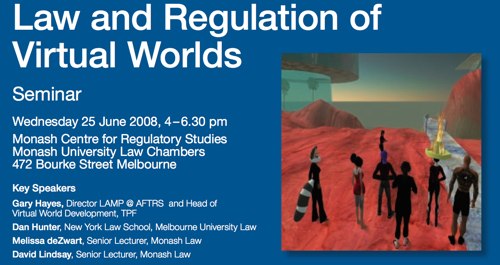
Melbourne keeps on churning out interesting virtual worlds events. This time it’s a seminar titled “Law and Regulation of Virtual Worlds”.

The details:

Wednesday 25 June 2008, 4 – 6.30 pm
Monash Centre for Regulatory Studies
Monash University Law Chambers
472 Bourke Street Melbourne

Key Speakers
Gary Hayes, Director LAMP @ AFTRS and Head of Virtual World Development, TPF
Dan Hunter, New York Law School, Melbourne University Law
Melissa deZwart, Senior Lecturer, Monash Law
David Lindsay, Senior Lecturer, Monash Law

This looks like a lively event. We’re in process of organising an interview with Melissa deZwart – watch this space.

Popularity: 4% [?]