Quantcast

Going mainstream means letting in the weirdos

Second Life’s generally considered to be a bit of a weird place. A lot of virtual environments are. They go through two phases of weirdness.

The first phase covers the first few waves of users. They’re considered weird because they’re doing something that isn’t usual: using a virtual environment at all, or using one that isn’t particularly well-known.

The second phase is when mainstream users start to trickle or flood in (and depending on the press that the environment has had, that can take place pretty close to launch). That’s when people start really doing weird things with it. Because landing the much-vaunted mainstream audience means nothing less than letting in all the weirdos.

Prior to that, you generally have people experimenting with the platform and the technology, seeing how it fits, where the money is, evaluating it for business, leisure, training, education, or just creating to suit themselves.

There’s typically no organized cadres involved, these are folks who are checking out the ground floor and determining if it is worth getting in on it for a long haul.

Generally, they’re smart, sane, sober, sensible, foresighted and farsighted people. You know, not really what’s considered normal.

Even so, playing the percentages, you’ll find a very small number of griefers, louts, firebrands and locos among them. It’s hardly a large number. Prior to maturity many virtual environments require a good deal of work, and that keeps a lot of the bad elements away.

Later, though. Well, let me tell you a story.

So, there’s an event on, and one of the attendees (appearing as Captain America) sexually harasses one of the venue staff. An abuse report takes place, and governance comes to take care of it. Unfortunately, they’re faced with so many Captain Americas at the venue that there is a little bit of difficulty identifying the culprit.

Only in Second Life, right?

Well, wrong.

A fellow by the name of Adamcik was at a bit of a shindig dressed as Captain America, but it’s okay, pretty much everyone was dressed up as something – though apparently Captain America figured very prominently. He had a burrito and a joint stuffed into his crotch.

He pestered women at the event to touch his burrito. Whether he made comedic humping motions with his hips at the time is a bit unclear. Apparently tiring of these japes, he allegedly groped a barmaid. While his behavior wasn’t exceptionally out of place at the event, he’d crossed a line.

The police were called in, but were faced with so many Captain Americas … well, the police report said “there were so many cartoon characters in the bar at the time, all Captain America’s[sic] were asked to go outside for a possible identification.” Adamcik apparently tried to evade identification by removing the burrito from his tights and concealing it in his boot. Nevertheless, he was hauled off to the lockup.

There, he attempted to flush the joint that had been concealed in his tights, but it was recovered by a police officer.

Adamcik was laid with charges of battery, disorderly conduct, drug possession and trying to destroy evidence.

Some college hijinx was it? No. Adamcik is a 54 year old family physician and the whole event was an American Medical Association shindig out in the physical world.

Yep, that’s right. Adamcik is one of those “normal mainstream people”.

Hey, mainstream dudes? You’ve lost any moral high-ground to call us virtual-environment users ‘weird’. Seriously.

This sort of thing isn’t an isolated incident. This sort of human behavior (and quite a bit that makes this look unexceptional) happens in virtually every human community on earth, every day.

That’s the mainstream. Get a few hours of XBox Live voice communications some time, but have a suicide hotline on your speed-dial first.

Even if the percentage of weirdos in phase one and phase two users remains constant, essentially opening your doors to the mainstream means opening your doors to the weirdos, the locos, the louts, the griefers, conspiracy theorists and every other kind of oddball our modern society spawns.

Come one, come all.

Also, as Linden Lab has noted on a number of occasions and most corporate IT staff will tell you, the average mainstream computer user finds the download and installation of software to be an obstacle, and sometimes an insurmountable one (unless, inexplicably, it’s some 3D screen-saver that installs malware onto computer networks).

Are those really the sort of people who are going to get a major benefit from a virtual environment and a digital economy? Maybe, but per-user they’re going to be incredibly costly to support, and that cost multiplies as their numbers increase.

If you really want to try to court the mainstream markets, you need to be prepared, and you need to give up caring whether people think your virtual environments are weird or sad or filled with folks living in their parents’ basements. That’s the mainstream, and if you want that, you go big or go home.

Popularity: 1% [?]
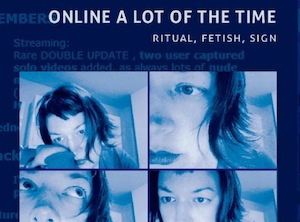
Book Review: Online a lot of the time


Online a lot of the time
Ritual, Fetish, Sign

Author: Ken Hillis
Publisher: Duke University Press

When my editor sent me this book to read and review, the title and intriguing cover image prepared me for an engaging and witty romp through online usage, telepresence, identity and more littered with illustrative reminiscences. Something to be read, savoured and enjoyed.

In that, I was initially somewhat disappointed. The book is truly dense, more reminiscent of a thesis (or several), backed with copious notes and bibliography. The dichotomy between title/cover and contents amusingly reminded me of the old maxim about judging a book by its cover. Nevertheless, I stalled on my first attempt to tackle the book; and then again on the second attempt.

The third time around I’d adjusted my expectations, and Hillis’ treatise does actually contain everything that I’d been looking for, and quite a bit more.

You might be fooled into thinking that the book is about the Web, virtual environments, online chatrooms and so forth. It isn’t, really – at least not solely. It’s about us … people, humanity, society, groups and individuals. It’s about our psychology, narratives, fetishes, quirks, rituals, expressions and signs.

It’s about the one thing that makes the virtual environments, the Web, and the Internet important: people.

Are networked individuals always running after the truth that passes them by even as it remains right behind and within them, a part of it lingering, like a cosmetic, on the surface of their “soul”? Does ‘here” for them always already mean “everywhere else”? These are the questions that, ironically, tend to get dismissed as (implicitly the “wrong kind” of) metaphysics by those who argue for the experiential reality of digital telepresence. – From “The Political Trace”, Chapter 3: SIGNS

You might find the prose and style to be fearfully dense, with paragraphs often running for more than a page. This is no ‘For Dummies’ book. This is one for the serious thinker who wants to be treated like an adult, and not coddled or talked down to.

Words and images, operating within specific sociopolitical circumstances, differently represent the possibility and potential of experience without a subject. However, particularly given the digitization’s opening of typography to new forms of visual design, there are increasingly meaningful overlaps in the ongoing expectations we bring to typographic and image forms, even as they each help organize in different ways what we find meaningful and how we do so. Theorizing the increasingly leaky experiential boundary between words and images has important implications for how subjectivity is organized if we are at the historical conjunction where the Web must be taken seriously as not only beginning to renovate some of literature’s forms but also forms of social relations. – From “Graphical Chat’s Debt to Free Indirect Discourse”, Chapter 4: AVATARS BECOME /ME

While I may not ordinarily be able to compose a higher praise for a book than that it makes you think good and hard about its foundation and topics, perhaps there’s something to be said for at least some accessibility.

Whether the text contains any truly revolutionary thought on the subjects of virtual environments, avatars, identities and telepresence is a bit harder to say. It has given me so much to think on that it could be quite some time before I can reasonably answer that question.

Nevertheless, if you’re an avid, virtual-worlds thinker with a mature attitude and able to keep your head above water in the deepest portions of the English language vocabulary, this book is definitely for you.

Popularity: 1% [?]

Alice has a dollar. A virtual economic failure

Alice and Bob are participants in an economy. Alice has a dollar.

Alice gives the dollar to Bob. In Second Life terms, that’s a user-to-user transaction.

Bob gives the dollar back to Alice. That’s another user-to-user transaction.

Repeat this sequence four more times. Is Alice and Bob’s economy now worth ten dollars? Or is it still worth one dollar?

Well, that depends.

Linden Lab will tell you that’s ten dollars. In reality, though, it depends on why Alice and Bob keep handing that dollar back and forth.

You see economic activity isn’t the movement of money. Economic activity is the trade in goods and services, not money. Money is just one of the tools that are used to value goods and services.

If Alice and Bob are just passing money to each-other without an exchange of goods and services, the economic activity – by definition – is zero, whether there’s one dollar or a thousand dollars, and whether it’s just Alice and Bob, or hundreds or thousands of other people involved.

The movement of money is one method by which we can see economic activity happening, but doesn’t constitute economic activity itself, just as we can determine the approximate size and movement of ducks on a pond by watching the ripples – but the ripples aren’t the ducks.

In any economy money moves between people, between accounts and between businesses for many reasons that do not constitute economic activity. Also, the exchange of goods and services for no money at all still constitutes economic activity of a non-zero value.

Alice and Bob might be exchanging goods or services, in which case there’s economic activity accompanying that dollar in their inefficient little economy. If so, then yes, Alice and Bob’s economy is worth ten dollars. If not, then their economy isn’t worth ten dollars, or even one dollar. It’s zero, because no economic activity accompanies the exchange.

Economics understands this, and when measuring the economies of nations, considerable effort is spent to separate out the movements of money which are not accompanying economic activity from those which are.

Granted, for any economy much larger than Alice and Bob’s it requires a lot of estimation and educated guesswork to get even remotely close to the truth, but the practices are well-established (even though they undergo continuous improvement).

For virtual environments, though, centuries of economic thought and learning are discarded, and the focus is incorrectly placed solely on the movements of money. Small wonder that the operators of many virtual environments really seem to have no idea which direction their economies are actually heading in.

Popularity: 1% [?]

Avatar: The film, the idea and the word

James Cameron’s new film, Avatar, teaches us nothing about avatars.

Why? Well, let’s take a step back and look at the basic idea that already exists.

Most people are members of one of the 20 or so major religions, pretty much all of which have the concept of the avatar in common. Throughout religious philosophy and doctrine, your body and brain are considered to be your avatar, a vehicle for the actual you that continues on. The body is the avatar of the spirit (and in a couple of religions, the spirit itself is in turn an avatar of something outside).

Throughout our religious education and observations, the point is hammered home again and again – your body is your avatar in this world. This idea has now persisted for millennia, even though it is not widely associated with the word used to describe it.

And after thousands of years, it still hasn’t actually sunk in, even among many of the most devout.

From that perspective, virtual environments and avatars are a natural extension of our beliefs about the universe and our place in it. We’re just not really ‘getting’ that whole avatar thing, even though it is one of the central tenets of our varied religious beliefs.

Do I really think that James Cameron is going to be more successful with a US$237 million film budget where our most deeply held and treasured faiths about life and the nature of the universe have failed?

Not so much, no.

If you are already comfortable with the notion of an avatar, Cameron’s film doesn’t really add anything to your understanding. For those who are not, I put it to you that the concepts those people end up attaching to the word, based on the film, will not be the same ideas that you already hold from experience.

Either way, we’ve gained nothing in our understanding of the concept of the ‘avatar’, and sometimes I wonder if we ever really will, as a culture.

Popularity: 1% [?]

Alter Ego on SBS, and thoughts on vocabulary, identity, truth and perspective

wolfie-alterego-smlSo, here I am, watching the Alter Ego documentary on SBS. Indeed, it is still running at the time I am writing this. I’m not really quite sure what I expected. Not the usual sense of regretful chagrin that I’d expect at a documentary on Second Life, because Writer/Director Shelley Matulick is basically a good sort.

Nevertheless, the emotion that most comes to the surface right now is one of frustration.

“Real world”, “virtual world”, “real”, “fake”, “virtual” terms and prefixes are thrown around with little consistency, and make me wince or cringe.

It’s not really anyone’s fault, exactly. The users presented on the program lack the vocabulary to clearly express their experience. They obviously have a firm emotional and instinctual grasp of it, but not the conceptual vocabulary to clearly explain it to others.

For the part of the viewer, the average non-virtual-environment-user, well, without enough first-hand experience or a few doctorates in philosophy it’s really hard to absorb the concepts. Until we take our lives online in a decisive sort of way, we don’t really give much thought to core issues like identity or the fundamental nature of humanity – issues that remain relatively intractable after thousands of years of thought by the best minds that our species has to offer.

With such vast conceptual gulfs, how do you convey the obvious?

Good luck trying to explain it to someone who doesn’t have the common experience of a different perspective. Remember in Sesame Street, they had a number of animations that explained communication? One figure with a series of coloured shapes in their head, and as they spoke, the other person wound up with similar coloured shapes in their own head.

What we lack is a vocabulary to express the colours and the shapes. I tell you that there’s no difference between virtual identity and non-virtual identity.

In interviews with the BBC, I was often asked “What is the difference between virtual identity and real identity?”

The obvious and correct answer is that there isn’t any difference. If that doesn’t make sense, then it’s because you’ve misunderstood the nature of identity itself, rather than the nature of virtual identity.

It’s simple, it’s obvious, and if it doesn’t convey the proper concepts to you, then as a message it’s wrong, even if it’s the truth.

This is why the parable (παραβολή) was originally developed – sometimes a fictitious story can convey more truth than the factual one. If simpler truths cannot be grasped, metaphors, analogies and parables need to be employed. Rectitude is not only in possessing the truth, but in effectively sharing it.

Virtual environments, somewhat paradoxically, tell us more about the nature of our ordinary mundane world and selves than actually living it, because in order to grasp the nature of something very large or very close, you need perspective.

If you’re paying attention, a year of using a virtual environment will teach you more about humanity, identity and gender than 30 years of actually experiencing those things first-hand. If you’re not paying attention, though, it may teach you nothing at all.

Popularity: 1% [?]

Surfing the virtual world hype

Riding the hype wave of a new technology with a “world-first” isn’t exactly unusual. We’ve seen this a lot with Second Life, right?

But there’s actually other, more interesting lessons to be learned.

Firstly, the newspapers and magazines don’t really check if you’re first, so if you want you can just copy what someone else is doing. This happened a whole heck of a lot. If anyone actually does ask, you just slice it more finely. “First by a Fortune 500 company”, “First by a West-coast marketing firm run by octogenarian teachers”. Slice it finely enough and you can pretty much always claim a world first – and by golly, they do.

There were, from memory, four national embassies that opened in Second Life. Each claimed to be the first one (presumably using the slicing technique above, or just not doing the research). That brings us to the second technique, the one that gives you the most PR bang for the least buck:

Don’t actually do it. Seriously, this is a proven strategy.

Write and issue your press-release, outlining what amazing world-first you’ll be performing – then don’t follow through. By the time that peak of the hype cycle wore off, nobody noticed that you actually didn’t. Instead it became a fait accompli. Everyone more or less assumes that you did do it.

Assorted media pieces still refer to pizza-deliveries, programmes and concerts by famed celebrities that never actually happened, but the writers just assume that they did.

There’s your return-on-investment right there. All the hype, and none of the work. All you have to do is hit the timing right on the cyclical hype.

There’s a whole lot of businesses and organizations using Second Life in various ways. Many of the ones that you can name from media-coverage though, never actually did. However it didn’t apparently actually harm their PR efforts at all.

Anyone want to bet that this won’t happen with future virtual environments?

Popularity: 1% [?]

Linden Lab launches Second Life Enterprise beta today

enterprise_secondlife Linden Lab will announce today that their second “work offering”, Second Life Enterprise, is entering an open beta period, prior to release. The preliminary beta for the Second Life Enterprise has been running since April this year; the open beta program will run through Q4 this year, and general availability will be announced during the first half of 2010.

The associated service, the Second Life Work Marketplace, which is currently in development, will go into closed alpha at the end of Q1 2010.

The Second Life Enterprise bundle is priced from US$55,000, and this price will cover both hardware and software sides of the solution; two servers will be provided, one for spatial voice (VOIP) and one for virtual environment simulation of up to 8 regions, supporting a maximum of 800 users (though 800 users with spatialised voice seems like a recipe for chaos).

There is no indication yet as to whether the Second Life Enterprise product will replace Immersive Workspaces, the Lab’s first and, to our knowledge, only other, “work offering”, or whether the two will exist in parallel.

Organisations already participating in the beta program include IBM, Northrop Grumman, Naval Undersea Warfare Centre, DefenseWeb Technologies, Case Western Reserve University, and The New Media Consortium.

Intriguingly, Linden Lab has announced that “content owned by the company can be moved from the main Second Life environment into the Second Life Enterprise Beta environment”.

This, of course, raises many questions. Technically, by the Second Life Terms Of Service, Linden Lab has the right to distribute other people’s content for any purpose related to the operation of the service without explicit permission from creators.

Will any and/or all content on a simulator owned by a company be able to be sucked up and spat out again in the Enterprise environment belonging to that company? How will content ownership be determined?

What will happen with third party content, given these circumstances – especially given that a lot of enterprise presences on the main Second Life grid are composed of a reasonable percentage of third-party content already, under wildly different permissions.

Of course the Lab can bundle that up and copy it all off-grid. They have that right, so long as it continues to be “a part of the service.”

These issues aside, though, Second Life Enterprise looks to be a solid business product, particularly for virtual meetings, prototyping and data visualization – three areas where Second Life technology does well.

Popularity: 1% [?]