Quantcast

Group instant messaging and successful meetings in Second Life

Linden Lab have posted two useful stories on their blog that are worth passing on.

The first is a heads-up on a Knowledge Base article on how to instant message a group of up to 20 of your friends without them being in a group you’ve created.

virtual_meeting

The second is a look at how an in-world meeting was held for 160 people in Second Life. The standout sentence for me was:

Gronstedt led all participants through a 30-minute training session and all speakers and exhibitors through a 60-minute training session to ensure that when the conference day arrived, everyone was ready to walk, talk, text chat, and participate in this new virtual event experience.

Half an hour to an hour of training to be able to participate isn’t that high a premium, although without doubt it’d be a disincentive to a lot of people. To me, that’s a big hurdle for one-off meetings but a more than worthwhile expense for a business using virtual meetings regularly. Of course, the enterprise solution that reduces the learning curve even further will have an advantage as enterprise comes on board with offerings that reduce real-world travel expenses.

Popularity: 4% [?]

Enterprise 2.0 and virtual worlds and a free discussion paper download

enterprise20shortpaper Today, I had the pleasure of facilitating four small group sessions at the Enterprise 2.0 Executive Forum 2009. The topic was virtual worlds and enterprise, and thanks to the participants in the groups, it turned into a very interesting exchange of ideas. The agenda of the overall forum was much wider: the use of Web 2.0 technologies in business. What’s impressive about this forum is the breadth of roles amongst participants – CEOs, CIOs, learning and development professionals, marketing professionals and general operational staff were in attendance.

As I’ve found before at these events, there are a growing number of people in business who see the potential of virtual worlds, but they struggle to get the same recognition throughout the business. That said, Australian business continues to lead the way in the area and it was great to see the level of passion for the opportunities virtual worlds provide.

Some other points that came out of the groups for me:

  • There’s a genuine acceptance of the potential of virtual worlds as an effective collaboration tool;
  • The awareness around the power of telepresence is growing steadily – close to half of the group members already understood the concept well and most had experienced its superiority over teleconferences or videoconferences first hand;
  • Enterprises want pilot virtual worlds but arguing the ROI case remains the main barrier, along with the significant end-user resistance that occurs;
  • That Second Life’s interface and the fact it’s a standalone application are major barriers to implementation;
  • There remains very high desirability for web-based worlds that deliver the level of complexity of Second Life
  • As part of my involvement I produced a four-page discussion paper: Virtual Worlds in the Enterprise – hype or high-performance?. It’s a bare-bones overview of the opportunities virtual worlds provide for business and a brief summary of five virtual worlds to watch (Second Life, VastPark, OpenSim grids, OLIVE and Metaplace) – there are obviously many more but as an overview they provide a good snapshot.

    Anyone regularly exposed to virtual worlds won’t get a lot out of the document, but if you’re one of our readers who’s just dipping their toe in the water, it provides a basic launch pad for a wider exploration.

    You can download Virtual Worlds in the Enterprise – hype or high-performance? for free by going to this page.

    You only need to provide your name and email address to be able to download a PDF of the paper.

    Popularity: 6% [?]

    Virtual worlds: the next online banking

    westpac Aside from the group discussions on virtual worlds I facilitated yesterday, the only other time I witnessed them discussed at the Enterprise 2.0 Executive Forum 2009, was when Westpac’s David Backley spoke. As we reported last year, Westpac had trialled the use of Second Life to induct new employees in more remote locations.

    Backley reflected back on the pilot, stating that it “had worked well and had been a good idea”. That said, the pilot did not continue due to the departure of the project sponsor – there was no key person to keep the momentum going. The learnings for Backley were that it was a concept ahead of its time, and that until the cost of implementation and maintenance came down, it would be difficult to argue a cost-saving case. Given the tens of thousands of employees Westpac has, it’s a pretty downcast assessment of virtual meetings as cost-saver. That said, Westpac’s platform of choice was Second Life. With the growth in alternate platforms, those costs are reducing, but there’s still a long way to go in that respect.

    Aside from that, Backley provided some very interesting statistics around Westpac’s internet banking service. Presently, up to 6000 people are logged in to Westpac’s online banking service at any given time, with close to 700 thousand sessions a day. More value is transacted with online banking per day than is done in Westpac’s branches or call centres. When it was launched a little over a decade ago, the expectation was that perhaps a few thousand people Australia-wide would use the service. For me, that’s a key parallel with virtual worlds. It may be a ‘niche’ for business at present, but like internet banking, the public’s takeup is likely to surprise enterprises in a big way.

    The other similarity is in platform: the original internet banking options tended to be standalone applications, then they evolved to be web-based. That’s when the rate of adoption exploded. There’s a very obvious lesson there.

    Popularity: 6% [?]

    NoviCraft: virtual world team building

    novicraft NoviCraft is one of the more fascinating virtual world business offerings by Finnish company, TeamingStream. That fascination comes not from the platform itself, but the theoretical underpinnings of it. This is a world designed purely for business-related training and team-building purposes.
    I took the opportunity to fire a few questions at TeamingStream’s CEO, Petri Ahokangas, about NoviCraft.

    Lowell: What platform is the application built on?

    Petri: NoviCraft is built on Epic’s Unreal Engine and it was officially launched in December last year. NoviCraft is off-the-shelf multiplayer teambuilding, collaboration, and leadership training game developed by a group of learning scientists, human resource development specialists, and serious game developers for the corporate learning industry. Our customers include top HRD consultancies, big and medium-sized companies, universities and other training organizations.

    Lowell: Could you give more detail on the team building specifics that are encountered in the game?

    Petri: The game is pedagogically scripted to make the participants aware of the different elements of collaboration, team learning, negotiation, and leadership through five team puzzles – and thus learning from the game experience. The first puzzle focuses on enhancing communication, building of psychological trust, and giving and receiving help among the participants. The second puzzle is about encouraging exploration, coordination of work, and establishing goal orientation. The third puzzle encourages
    Thinking–out–loud as a team, sharing of information and helps to create an efficient problem-solving skills for the participants as a team. The fourth puzzle brings in risk taking and strategy creation as a team. The final puzzle is about joint planning and efficient execution of the plan.

    In a nutshell, all major challenges of the modern workplace have been modeled to the game and can be practiced in a safe environment in a cost effective way. NoviCraft is not a simulation, it is real collaboration between people which makes it very effective as a learning tool. The learning process is theoretically grounded, supported by metrics, and the trainer or consultant (the game master) can monitor and control the performance of the playing team.

    Lowell: So what have been some of the more common utilisations of NoviCraft to date?

    Petri: Typical use cases for NoviCraft include leadership and management training, cross- and multi-cultural collaboration, virtual and distributed team collaboration training, team building, supervisor training, personnel evaluation/appraisal, and coaching boards of directors and management teams. Our customers have said that NoviCraft is a fun and efficient way to learn about their teamwork skills and it helps both individuals and teams to improve. After the game the participants can go through a workshop where they can analyze their performance, strengths and areas where they need improvement. The NoviCraft game experience can also greatly add the value of traditional management and leadership training.

    Lowell: What level of expense is an enterprise looking at to deploy NoviCraft?

    Petri: NoviCraft’s price depends on the number of users and the constellation of the software, but the typical limited license is between twenty and forty thousand Euros (20000-40000 €) depending on the case.

    Serious games initiatives are nothing new, but Novicraft seems to be one of more fleshed out models for business. At close to forty-thousand dollars Australian to implement, only the larger enterprises would consider NoviCraft, but its breadth remains appealing. What will truly differentiate NoviCraft is its touted metrics: if tangible benefits for a business are realised, its implementation costs may suddenly seem less of a barrier.

    Thanks to CyberTech News for the heads-up.

    Popularity: 7% [?]

    Linden Lab’s enterprise momentum

    In one of the more illuminating posts on the Official Linden Blog in recent months, Linden Lab’s Director of Enterprise Marketing, Amanda van Nuys (SL: Amanda Linden), has outlined the potential uses of Second Life for business.

    virtual_meeting

    There’s nothing groundbreaking in the information, but it’s worth regurgitating some of her points to illustrate virtual worlds and enterprise in a wider context.

    Ok, I admit it. When I first joined Linden Lab to head up Enterprise Marketing three months ago, I wasn’t 100% convinced that working in virtual worlds really works.

    A refreshingly honest take and one that most people would identify with, when introduced to virtual worlds for the first time. There’s a fundamental skepticism that I come across on a daily basis – one that’s hard to combat, even with facts around virtual worlds usage and their advantages for business.

    The virtual medium is extremely powerful and the ‘sense of presence’ is real—and that’s the magic ingredient that makes a meeting truly productive.

    For those who inhabit virtual worlds, this is also self-evident, but it’s another aspect that’s difficult to illustrate to the business skeptic. The recent increase in awareness of virtual meetings as cost-savers may actually be the factor that overcomes the initial wariness so that the power of the solution comes through.

    Ok, I’m the Marketing gal who drinks my own Kool-Aid—true. But, I’m also a believer, and if you’re not already—you will be, too. Just try it and you’ll know what I’m talking about.

    Of course, Linden Lab touting the power of virtual world meetings is a little like a hamburger chain espousing the health benefits of their burgers. That said, the growing evidence around the efficacy of virtual worlds for enterprise supports their case, although it continually needs to be communicated in disciplined business terms. It’s been stated repeatedly that the current economic climate may actually be beneficial for virtual worlds and the enterprise. That may be true, but only disciplined ROI arguments will fully overcome the intrinsic skepticism entrenched in the minds of most business leaders.

    Popularity: 5% [?]

    2009: the year the ATO wakes up?

    In recent weeks over on Terra Nova, Julian Dibbell has raised the issue again of taxation and virtual worlds. It’s worth a read purely to gain some insight into the complexity of the issue. As Dibbell states, it’s a lot more than the concept of taxing the sale of virtual goods, although that’s likely to be the driving force of any actions by governments.

    linden-exchange

    On the Australian front, back in October 2006 the Sydney Morning Herald and The Age reported on advice from the Australian Tax Office (ATO), which was:

    People trading in virtual worlds should consider very carefully whether they are conducting a business or a hobby

    Since then, there’s been no real change in approach from the ATO – I’m not aware of any campaign to enforce taxation on earnings in virtual worlds. One assumption would be that enforcement is so fraught with difficulties that it remains in the ‘too-hard’ basket, and rightly so. Even in the two or so years since the ATO made that comment, there are even more complicating factors, not least of which is the continued growth in virtual world platforms. Imagine trying to audit a virtual world entrepreneur who makes money in Second Life that he /she partly cashes out in US dollars whilst keeping the bulk in-world in Linden Dollars. If they then operate their business on an OpenSim grid with a different virtual currency, you can imagine the compliance nightmares for the entrepreneur, let alone the ability of the ATO to make any sense of the whole operation.

    That said, in a real-world environment of shrinking tax revenues and the growing focus by the US Government on the issue, it’s hard to imagine the ATO are going to continue to sit on their hands for another year. A sensible start would be an inquiry into the challenges of virtual taxation, with the opportunity for virtual world users to provide submissions on a way forward. It would be potentially disastrous if a heavy-handed approach eventuated, that impacted on the multitude of small business people operating successfully in worlds like Second Life now.

    The hobby/business continuum has always been a grey area – the only sensible approach for those operating business in virtual worlds is to assume they have a business, not a hobby. With that approach, whenever regulation does eventuate the transparency is already established. Increased regulation seems an inevitability – it’s how that regulation is implemented that will need to be watched closely.

    What are your thoughts – can you see the ATO getting more active in the area or is the cost of ensuring compliance too great for the potential returns?

    Popularity: 5% [?]

    Companies and 3D Virtual Worlds: one detailed analysis

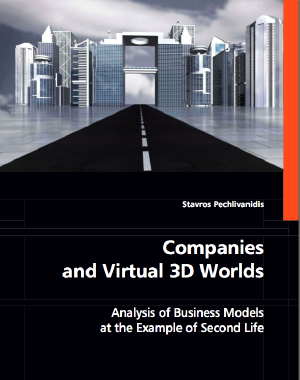
    stavros There’s an ever-growing pile of books on virtual worlds available, ranging from tour guides to detailed ethnography.

    One publication that slipped under the radar for me at least (it was published in May 2008) is Companies and Virtual 3D Worlds – Analysis of Business Model at the Example of Second Life. Written by Stavros Pechlivanidis, a Managing Consultant and IT Specialist for IBM Global Services, this book is actually a Masters Thesis for Pechlivanidis’ MBA studies, and it shows. I mean that in a positive way, in that it’s apparent a lot of research has gone into the final product. That said, this isn’t a book for the faint hearted and is probably only suited to people working in business who are taking an in-depth look at the applicability of virtual worlds for their enterprise. Publisher VDM Verlag kindly provided me a review copy, so read on for my thoughts below.

    What has impressed me with this book is the strategic view it takes. There’s plenty of information on the macro environmental factors impacting virtual worlds (political, social, economic and technological), including some great evaluation of these factors:

    Other aspects covered include virtual world industry segmentation and their individual success factor, and a business model overview for virtual worlds. This leads directly into the guts of the thesis: analysing the different business models within Second Life. Everything from Anshe Chung to currency exchanges are examined in the context of the research literature on business models more broadly. Three broad categories are cited: C-Business (creative business models), I-Business (interconnectedness between real world and virtual world or between different virtual worlds as a way of doing business) and V-Business (virtual business occurring solely in a virtual world). It provides Pechlivanidis a springboard from which to analyse the strategic opportunities for business across all three spheres.

    Overall, this is an extremely comprehensive book that is aimed squarely at business. It’s breadth and rigour make it a desirable reference source as business shows more interest in virtual worlds. It stands out for its provision of new information rather than just summarising information found elsewhere, which isn’t unexpected given its academic underpinnings.

    You can buy the book from our bookstore by clicking here or if you’d prefer we not get a (very small) cut, the direct Amazon link is here.

    Popularity: 4% [?]