


The Watch – virtual worlds in the news
October 27, 2008
1. CNET (USA) – Metaplace secures funding for its virtual world. “Metaplace, a company that plans on letting users build a virtual world and use social networking conventions to allow groups to enjoy them, announced today that it raised $6.7 million of funding in a round that was led by Charles River Ventures and Crescendo Ventures, as well as independent investors, Marc Andreessen and Ben Horowitz.”
2. Salon (USA) – Muxlim Pal to be world’s first Muslim-themed virtual world. “For the last couple of years in Second Life, there have been reproductions of Islamic holy sites, including a virtual Mecca (with a virtual Kabaa), and a small handful of virtual mosques, including replicas of the Hassan II mosque in Morocco, the Chebi mosque (a replica of the Mezquita mosque in Cordoba, Spain), Istanbul’s Blue mosque and a few others.”
3. Times Online (UK) – Jilted Japanese woman questioned by police after ‘murdering’ her virtual husband. “It was a classic crime of passion: a bored husband walking out on his marriage, his spurned wife so enraged by the desertion that she was driven to kill him. The murder, in May, was swift and cold-blooded but justice is inexorable. The perpetrator, a piano teacher from the southern Japanese island of Kyushu, sits in police custody awaiting charges that could send her to jail for years. One thing sets this apart from the standard crime passionel, however: it happened in a virtual world to online characters in an interactive game. But the legal consequences for the “killer” are being played out in the real world.”
(The mainstream media have loved this story in the past few days – nearly 600 publications have run the story so far)
4. The Canadian Press (Canada) – Compulsive gamers build strong emotional attachments to online world. “When 15-year-old Brandon Crisp occasionally got out of line, his parents would discipline him with the method they believed worked best: take away his prized Microsoft Xbox. Steve and Angelika Crisp would eventually return the gaming console to the Barrie, Ont., teen, who would resume playing his favourite game, “Call of Duty 4,” late into the night.”
5. Sydney Morning Herald (Australia) – Reality bites? A second life is virtually yours. “Ricardo Malveira has a simple piece of advice for those faced with the grim reality of the slowing global economy: avoid it. While the Australian dollar and the All Ordinaries shed huge chunks of their value in recent months, Mr Malveira’s business has been booming; where other businesses in the retail sector have seen a downturn in demand, he has a long list of clients. The business Mr Malveira created with his wife, Maria, exists in the virtual world Second Life, though his profits and business prospects are more stable than those of the outside world.”
6. iReport (USA) – Virtually Very Angry. “n real life you have to deal with all sorts of emotions, joy, sadness, love and anger. CNN have asked the members in their Second Life group of ireporters to tell them about how people deal with anger in the virtual world and what makes them angry. Well, real life is stressful enough, as most people know, and sometimes anger is a hard emotion to cope with. I have seen people angry in Second Life when personalities clash and they argue, resulting to name calling and even using the limited power of SL weapons to pay their enemy back.”
7. Wired (USA) – Dutch youths convicted of virtual theft. “A Dutch court has convicted two youths of theft for stealing virtual items in a computer game and sentenced them to community service. Only a handful of such cases have been heard in the world, and they have reached varying conclusions about the legal status of “virtual goods.”
8. Globe and Mail (Canada) – U.S. campaign heats up in Second Life. “It’s not just Earthbound voters who are intensely following the U.S. presidential campaign: The race also is a hot topic in the virtual world of Second Life. John McCain supporters and Barack Obama supporters – more accurately, the personas they have created – meet regularly in Second Life, described on its website as “an online, 3D virtual world imagined and created by its residents.” They watch the presidential debates together. They make T-shirts, banners and yard signs. They hold voter registration drives and rally on Capitol Hill.”
9. PSFK (UK) – Augmented Reality, Virtual Insanity. “There is an old curse that goes like this: “May you live in interesting times” It doesn’t get any more interesting than two recent strange news stories about digital worlds sparking irrational behavior in the real world. These two items illustrate the weird problems we could be encountering on a regular basis as bleed-through increases across the border of the real and virtual worlds.”
Popularity: 2% [?]
Second Life servers to hit Singapore?
October 27, 2008
According to the Straits Times, Singapore-based Second Life servers are on their way to Singapore within six months. This is potentially good news for Australian users, although the news would be a lot better if it were Australian servers being announced.
Given the growing focus on Twinity in Singapore, Linden Lab need to be making some strategic moves in South-East Asia. Japan and Australia are the only two countries in the region that make the top twenty for active Second Life users, so there’s plenty of ground to be made up.
Of course, the story could be based on information with a level of veracity matching the ‘real soon now’ claim made by Linden Lab nearly 18 months ago in regard to Australian servers.
Popularity: 3% [?]
Twinity passes 50K beta users
October 25, 2008
According to the indefatigable Andrew Peters, mirror world Twinity has reached the landmark of fifty thousand beta users.
That’s certainly a good critical mass of users, and it comes on top of a big week for Twinity. The Singapore Government has awarded funding via its Media Development Office to Twinity developers Metaversum. The funds are to create a virtual Singapore with geo-tagging and geo-located media streaming. It’s certainly a show of faith in Twinity.
We’d love to hear from any Australian users that make up those fifty thousand beta-testers. How are you finding it so far?
Popularity: 2% [?]
Weekend Whimsy
October 25, 2008
1. CPA Australia in Second Life
2. DreamSphere v1.0 Demo – DJ Dee – Second Life
3. Warhammer Online: Beam – The Raid ( Epic Story / English)
Popularity: 2% [?]
Linden Lab announce blog revamp: same old?
October 25, 2008
Linden Lab’s Robin Linden has announced that the official Linden blog is undergoing a revamp. It’s a lengthy post that to me seems to repeat the same promises of previous months: greater communication and a more uniform user experience.
The aim of the revamp is for your login to be uniform across the whole Second Life experience, and there’ll be new Linden employee blogs. The timeframe though is a little grey:
We aren’t announcing a specific timeframe for the completion of each phase of the project right now, but we will keep you updated.
A month ago we opined on the growing secrecy at Linden Lab – the employee blogs will be a small step toward remedying that issue, assuming free reign is given to those blogging. Anyone like to take a bet on the chances of that?
Popularity: 3% [?]
Australians in Second Life Update – small declines
October 25, 2008
Linden Lab have released their metrics up until September 2008, and in the Australian context there’s been a slight drop in activity – 686,872.48 hours, which is nearly eight thousand hours less than last month. Across 10-15 thousand active users, that’s not a big drop and Australia maintains the 11th spot worldwide.
Overall:
- user hours dropped from 34.8 million to 33.2 million
- the number of islands owned jumped from 1,610 to 1,723
- in-world accounts with positive cashflows grew from 60,788 to 62,633
- premium accounts (those that people pay a monthly fee for) continued their decline to 83,23, down from 84,883 last month and December 2007 highs of 93,219.
It’s a mixed picture and I’ve had a lot of people ask me in recent weeks how the real-world economic issues is impacting Second Life. These metrics don’t point to a significant decline related to the worldwide economic downturn and I’m not seeing any erosion of confidence. That said, the worst of that downturn occurred in October from a public perception viewpoint, so next month’s metrics should make for fascinating reading.
What are your thoughts? Are you seeing people spend less in-world? Have your spending habits changed in recent months?
Popularity: 5% [?]
That’s QUT for YAWL in SL
October 24, 2008
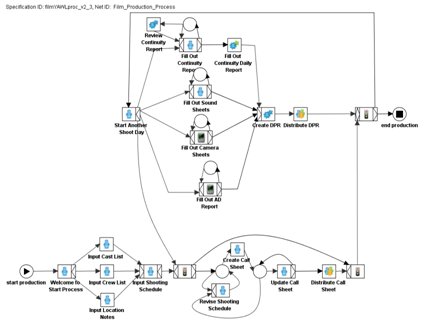
The Smart Services Co-operative Research Centre (CRC) is an Australian initiative designed to improve the service industry in Australia. The CRC partnership exists between 10 major industry players and six Australian universities. Its aim is the creation of research-enabled commercial outcomes for its partners. The current 7-year budget amounts to $120 million, with a grant of $30.8 million from the Federal Department of Innovation, Industry, Science and Research, and an investment of $38 million from the Queensland Government and its local partners (SAP, Suncorp and RACQ). The Queensland University of Technology (QUT) is the largest academic contributor.
YAWL (Yet Another Workflow Language), developed at the QUT, is one of the products that have been worked on as a part of the CRC initiative.
YAWL, “Yet Another Workflow Language”
Familiar with flow charts? Yes? That’s great, but will not help you here. Only a minority of control-flow patterns in workflow can be captured by classical flow charts. Nonetheless, they may be the first things you think of when confronted with a 2D YAWL control flow model – keep in mind that YAWL models are far more complex and sophisticated.
In the late 1990s, there were many workflow management systems around, each supporting a variety of languages. Created for the most part in isolation across industries, they used different concepts, different evaluation strategies, and different syntactic restrictions. It was difficult to compare one system to another – no single system could be used to encompass the full range of workflow possibilities.
The Workflow Patterns Initiative is a joint effort of Eindhoven University of Technology (led by Professor Wil van der Aalst) and QUT(led by Professor Arthur ter Hofstede). It was begun in about 1999. The control-flow perspective is one of several perspectives that can be distinguished in process-aware information systems – it captures aspects such as parallelism, choice and synchronisation. Originally 20 patterns were proposed for this perspective, however the latest iteration contains over 40 patterns. The patterns are language-independent, allowing an objective comparison between approaches to workflow management systems.
YAWL grew out of the Workflow Patterns Initiative.
YAWL’s original purpose was to act as a reference language. YAWL is a concise and precisely defined language that comprehensively supports many of the control-flow patterns.
“YAWL, like any other workflow management system, glues together people and applications in order to support processes as they may occur in businesses. It can offer work to the right people at the right time. Here it is important to understand the main perspectives one can have on a workflow:
1) control-flow perspective: what are the tasks involved and what is their order
2) data perspective: what information is involved and to what workflow components is this information visible
3) resource perspective: how is work distributed to the various participants (e.g. is it done on a pull-based or a push-based basis) and on what basis (e.g. a certain task may only be offered to those that play a certain role).
Workflow management has applications in many different domains.” – Professor Arthur ter Hofstede
YAWL Applications
YAWL4Film is currently being used with success in the Australian Film industry. Other YAWL applications are available for Business Process Management, the healthcare sector, and for product recall.
Dr Ross Brown and his team at QUT have been using YAWL to specify quests within online games – a game specific form of workflow – for some years now.
The YAWL – Second Life connection
“Once I had realised that you could link YAWL to a 3D environment for game control purposes, it became obvious that other areas could benefit if we used a more general environment such as Second Life. So, this year we utilised Second Life’s service invocation interfaces to allow it to talk to YAWL via a custom service – YAWL has an SOA architecture amenable to the creation of custom services interfaces. You can see some details about this project on my blog at http://bpmve.blogspot.com/2008/07/yawl-and-second-life-linked.html. In the example we have the workflow tool controlling an avatar, animating a workflow describing the processes involved in film production. The thing to note is that the avatar is controlled from outside of SL, it is not scripted within SL at all.” – Dr Ross Brown
YAWL comes with a visual editing tool with which to create workflows. Educational scenarios can effectively be created this way. The CRC project involves the creation of more such tools to allow educators to easily create lesson plans within digital environments like Second Life.
“We can also use YAWL to create virtual, training environments for industries such as health, mining or fire fighting where the actual danger is removed but people can train in a realistic environment.” – Dr Ross Brown
Via QUT News.
Popularity: 5% [?]


